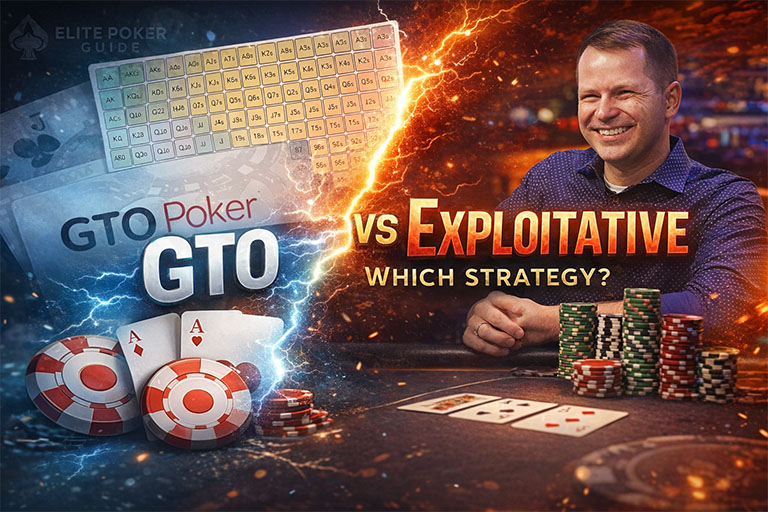
The GTO vs exploitative poker debate has defined how players think about strategy for the past decade. One side says: play theoretically perfect poker and nobody can beat you. The other says: forget balance, find what your opponents do wrong and punish it. The truth? The best players in 2026 don’t pick one — they use both, and knowing when to switch gears is the real skill that separates crushers from break-even grinders.
This guide breaks down both approaches from the inside, shows you exactly where each one prints money, and points you to the courses and tools that teach each strategy at the highest level. Everything referenced is available at Cash Poker Courses with manual delivery after payment confirmation.
If you are still comparing study paths, our guide to the best poker courses breaks down the strongest options for cash, MTT, PLO, beginners, and advanced players.
What GTO Actually Means (And What It Doesn’t)
GTO — Game Theory Optimal — is the strategy that cannot be exploited. If you play perfect GTO, your opponent’s best response is to also play GTO, and neither player can gain an edge. It’s the Nash Equilibrium of poker.
But here’s what most players get wrong: GTO doesn’t care about your opponent. As Peter Clarke explains in his PIO vs. Population series, a GTO solver considers exactly three factors when building a strategy: range advantage, position, and stack-to-pot ratio. That’s it. The solver doesn’t know if Villain is a 40/5 fish or a 22/18 reg. It doesn’t care about fold equity, timing tells, or whether someone’s line “makes sense.” Those are human concepts — and they’re banned in GTO mode.
What GTO gives you is a baseline. On a KQJ rainbow board as BTN vs BB, the solver says: bet 57.6% of your range at 50% pot. It bets AA at 97% frequency (obvious), but also bets 22 at 85% frequency (not obvious at all). Why? Because when your range is loaded with value, you need bluffs from unexpected hand classes. Betting only natural semi-bluffs like Tx and Ax would make your checking range far too weak and your betting range far too strong on certain turn cards.
This kind of insight — that you should sometimes bet two-out semi-bluffs to stay balanced — is something you’d never figure out through intuition alone. That’s the power of GTO study.
What Exploitative Play Actually Means
Exploitative poker is the opposite approach: instead of playing a balanced strategy that can’t be beaten, you identify specific mistakes your opponents make and design your strategy to punish those mistakes as hard as possible.
If Villain folds to c-bets 70% of the time, you c-bet 100% of your range. If Villain never folds to river bets, you stop bluffing rivers. If the population overcalls flop bets but folds too much to turn barrels on scare cards, you barrel every Ace and King turn with air.
Nathan “BlackRain79” Williams built one of the most documented winning records in micro stakes history — over 5 million hands and $44,000+ profit at the lowest levels — using a purely exploitative approach. His strategy is straightforward: play TAG (tight and aggressive), c-bet 2/3 of flops heads-up, fast-play strong hands because opponents love to call, and never bluff calling stations on later streets. No solver required. Just disciplined execution of an exploit-first game plan against a population that makes predictable, massive errors.
The Saulo Costa Dose of Red Line course is built entirely around exploitative play — 29 videos targeting specific spots where regs deviate from equilibrium: overcalling vs. small c-bets, overstabbing turns on low boards, expanding preflop 4-bet ranges against tight opponents, and reversing perceived ranges. Each video is a surgical exploit designed to boost your non-showdown winnings.
📝 Nowhere is this more true than at the final table, where strict GTO often loses money due to ICM constraints and payout structures.
→ See real examples: Final Table Poker Strategy Under ICM
When GTO Wins
Against unknown opponents. When you sit down at a new table with zero reads, GTO is your default. You don’t know who’s tight, who’s loose, who tilts — so you play the strategy that can’t be exploited while you gather data.
Against strong opponents. At NL200+ and in high-stakes tournaments, your opponents are studying the same solver output you are. Trying to exploit a player who adapts quickly can backfire — they’ll counter-exploit your imbalances. GTO keeps you safe against players who are paying attention.
In spots with low information. Early in a tournament, blind vs. blind with no reads, multiway pots where you can’t model everyone’s strategy — these are all situations where GTO provides a more reliable framework than trying to guess what three different opponents might do.
For building your foundation. You can’t exploit deviations from GTO if you don’t know what GTO looks like in the first place. Studying solver output builds your understanding of what correct frequencies, sizings, and ranges should be — which then lets you identify when opponents deviate.
The Saulo Costa GTO Blueprint teaches this approach across 15 modules — covering every postflop line with downloadable Excel decision sheets and PioSolver files. The idea: build a pseudo-GTO game plan you can execute at the table, then adjust from there based on reads.
To understand how elite players actually implement these strategies in real decision-making environments, study:
https://elitepokerguide.io/how-elite-poker-players-make-decisions/
If you want to actually apply solver outputs in real games instead of just studying theory, read this guide:
📝 How to Use PioSolver in Real Games
When Exploitative Play Wins
Against recreational players. Fish don’t play anything close to GTO. They call too much, fold too little (or fold too much in the wrong spots), bet with unbalanced ranges, and ignore position. Playing GTO against a 55/8 whale means leaving massive amounts of money on the table. Value bet them relentlessly, stop bluffing, and watch the money flow.
At the micro stakes. NL2 through NL25 is an exploitative paradise. The player pool makes enormous, consistent errors — overcalling preflop, underbetting postflop, never check-raising, playing passively on turns and rivers. A well-crafted exploitative strategy crushes these games at a higher rate than GTO ever could.
When you have significant data. After 500+ hands on an opponent in your HUD, you know their VPIP, PFR, fold-to-c-bet, 3-bet frequency, and aggression factor across streets. At that point, you have enough information to build a targeted exploit. GTO doesn’t use this data — exploitative play turns it into profit.
When opponents have specific, persistent leaks. If someone folds to 3-bets 80% of the time, the maximally profitable play is to 3-bet them with almost any two cards — not to 3-bet at a balanced 8% frequency. The bigger the leak, the more aggressive your exploit should be.
The Upswing Poker Blueprint by Uri Peleg is designed around this principle: five core principles for exploitative decision-making. It teaches read-building, catching frequency mistakes, and Fishing Tricks — targeting weak players — rather than memorizing solver frequencies. The course includes a dedicated module on why the Blueprint doesn’t always match the solver, and why that’s fine.
📝 For a course-based example of exploit-first cash game training, read our Play It Smart Poker Courses in 2026 review:
https://elitepokerguide.io/play-it-smart-poker-courses-2026/
The Real Answer: Combine Both
The best players in 2026 don’t choose between GTO and exploitative — they use a framework Peter Clarke calls the three-step process: examine the GTO-recommended strategy, find how the population differs from it, then design adjustments to maximize EV. Theory first. Gap analysis second. Exploitation third.
Here’s what that looks like in practice on a KQJ rainbow board as BTN c-bettor:
Step 1 — GTO says: Bet ~58% of range at half pot. Bet strong one-pair hands at high frequency. Check stable medium-strength hands. Bluff with straight draws, Ace-high, small pairs, and even some total air with backdoor equity.
Step 2 — Population deviates: Most regs don’t bluff small pairs on connected boards. They don’t c-bet Ace-high enough when they have range advantage. Their betting range ends up too value-heavy. Their checking range gets overloaded with weak Ace-high hands.
Step 3 — Your exploit: As the BB facing their c-bet, you can overfold slightly since their range is value-heavy. When they check, you probe the turn aggressively because their checking range is stuffed with Ace-high they were too scared to bet. On turn cards that pair the Queen or Jack, you have a massive trips advantage because they almost never bet second/third pair on the flop — so you can lead small at high frequency and make their top-pair hands miserable.
This is how GTO and exploitative play work together. GTO tells you the target. The population tells you how they miss it. Your exploit is the adjustment that turns their miss into your profit.
📝 Start building your GTO foundation now: https://elitepokerguide.io/product/bluffthespot-piosolver-solutions/
A strong practical example of this hybrid approach is The Bluff Barbarian by Overnight Monster, which combines H2Note population data, PioSolver validation, and exploitative bluffing Gates. Read the full 2026 review here: https://elitepokerguide.io/the-bluff-barbarian-by-overnight-monster-2026-review/
Best Courses for Each Approach
GTO-Focused Training
Saulo Costa GTO Blueprint — 15-module postflop game plan with solver files and decision sheets. The most structured GTO course for cash games.
Carrot Corner Full Scholarship — Grades 0-3 plus Grade E. Peter Clarke’s graded curriculum blends GTO foundations with population exploitation through PIO vs. Population analysis.
GTO Lab MTT Poker Coaching — 154 hours of solver-based tournament training from coaches like Daniel Dvoress, Nick Petrangelo, and Ike Haxton.
GTO Lab Tournament Savagery — Advanced MTT course from Dvoress and Petrangelo focusing on solver-driven final table and deep run strategy.
PioSolver 3 — The essential tool for GTO study. Node locking, incentives, GTO trainer, and hand history exporter.
Exploitative-Focused Training
Saulo Costa Dose of Red Line — 29 videos of targeted reg exploits for non-showdown winnings.
Upswing Poker Blueprint — Principle-based exploitative framework with read-building, live play, and analysis of high-stakes hands.
BBZ Exploitative Poker Explained — BBZ’s dedicated course breaking down how to deviate from GTO for maximum profit against real opponents.
Upswing Elite Cash Game Exploits — Advanced exploit strategies for mid-to-high stakes cash games.
Hand2Note 4 PRO — The HUD that powers exploitative play. Dynamic stats, automated notes, expression engine, and player pool research.
📝 Related review: 2 Card Confidence Review — a technical breakdown of Preflop Xploits, Solver Mastery, and Flop Exploits for players who want to combine GTO baselines with exploitative adjustments.
📝 Uri Peleg’s Guerrilla Poker library is a strong practical example of exploit-first training. See the full Guerrilla Poker Courses in 2026 review for a course-by-course breakdown.
Courses That Teach Both
Nevir Poker Crush NL2–NL100 — Solver-informed preflop ranges plus play-and-explain sessions at every stake showing how to adapt theory to real opponents.
Play It Smart Bootcamp — 10 episodes targeting specific high-EV situations with a blend of theoretical and exploitative approaches.
MOBIUS GTO Stat Checker Cash ELITE — Compares your actual play to solver baselines. Shows you where you’re deviating — then you decide: is the deviation an exploit or a leak?
Browse all GTO-tagged courses at GTO Poker Courses and the full catalog at Cash Poker Courses.
FAQ
Should beginners learn GTO or exploitative poker first?
Start with exploitative fundamentals — tight preflop ranges, aggressive postflop play, value betting fish, and avoiding bluffing calling stations. This generates immediate profit at low stakes. Then layer in GTO study once you’ve built a solid baseline and want to understand why certain plays work. You need to know what correct looks like before you can identify deviations.
Is GTO poker profitable at micro stakes?
GTO is profitable at any stake since it can’t be exploited. However, pure GTO leaves money on the table against the massive leaks at NL2–NL25. An exploitative approach that targets the specific errors micro stakes players make will produce a higher win rate than strict GTO play.
To apply these concepts faster, explore our guide to affordable poker training with curated course picks for cash, MTT, and PLO players.
Can you play exploitative poker without studying GTO?
You can — and many profitable low-stakes players do. But studying GTO accelerates your development because it shows you what balanced frequencies look like, which makes it easier to spot when opponents deviate. Without that reference point, you’re exploiting based on feel rather than data.
What does gto vs exploitative poker mean in tournaments?
In tournaments, the GTO vs exploitative poker question shifts based on stack depth and ICM pressure. Deep-stacked early play favors GTO foundations. Short-stacked bubble play requires exploitative adjustments based on opponent tendencies, payout jumps, and risk tolerance. The best MTT players like those coaching at GTO Lab use solver-derived baselines then adjust for ICM and opponent types.
If you want to go deeper than isolated strategy concepts, read our full guide to Poker Courses Online. It shows how premium poker courses help players connect GTO principles, exploitative adjustments, hand review, and practical decision-making into one study system.
What’s the best way to study both GTO and exploitative poker?
Use PioSolver to study what GTO recommends for common spots. Then use Hand2Note to check how your opponent pool actually plays those spots. Design your exploits around the gap. Courses like Carrot Corner Full Scholarship and Saulo Costa GTO Blueprint + Dose of Red Line give you both sides of this framework.
Courses mentioned in this article
 Upswing Poker Destroy Live Cash
 DIAMOND TEAM COACHING€29.99
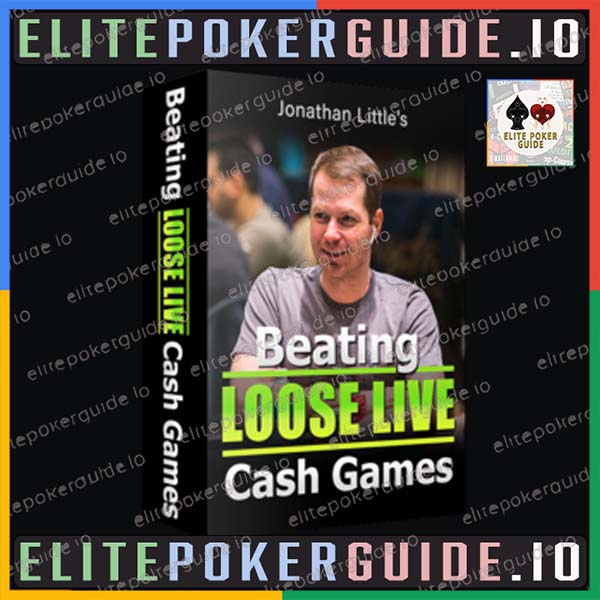 POKERCOACHING BEATING LOOSE LIVE CASH GAMES
 RUN IT ONCE YOUR ROAD TO MIDSTAKES