
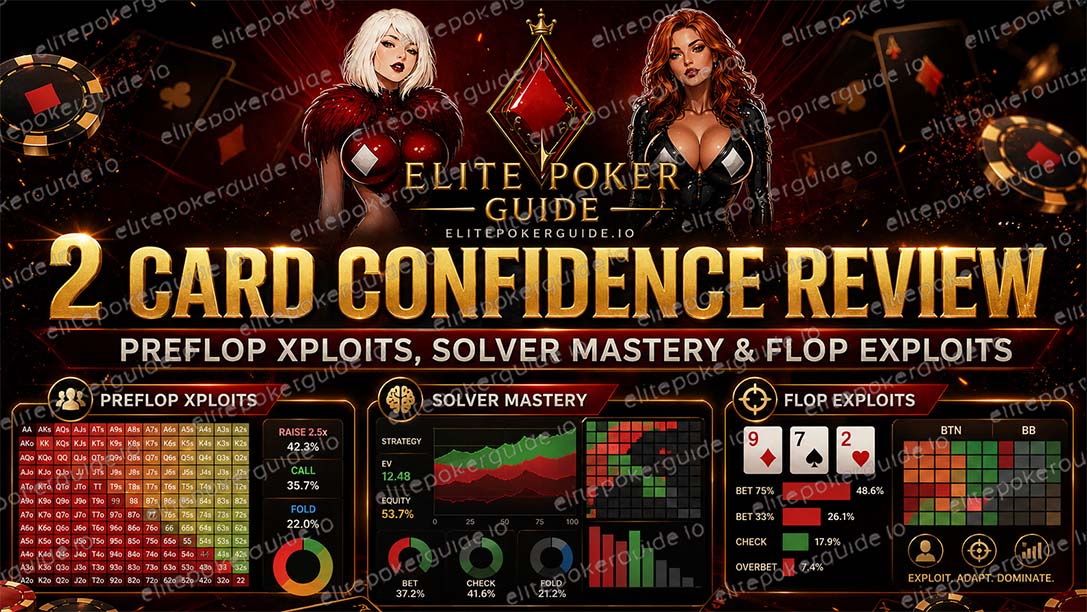
Full 2 Card Confidence review covering Preflop Xploits, Solver Mastery and Flop Exploits. See rating, pros, cons, verdict and best learning order for serious NLHE players.
Elite Poker Guide Rating: ★★★★★ 4.7 / 5
2 Card Confidence is not the kind of poker training brand built around motivational language, vague “think like a pro” advice, or shallow range charts. Its core value is more technical: it teaches players how to understand preflop ranges, solver outputs, exploitative adjustments, and postflop decision-making in a structured way.
This review covers three important 2 Card Confidence products available through Elite Poker Guide:
2 Card Confidence Mini-Course: Flop Exploits — a focused course on finding postflop population mistakes and turning them into practical exploitative decisions.
2 Card Confidence Solver Mastery — a solver-focused training system for players who want to understand how to study poker more efficiently instead of blindly copying outputs.
2 Card Confidence Preflop Xploits — a preflop exploit course built around GTO baselines, population tendencies, and practical deviations from equilibrium.
If you are comparing poker training options, you can also browse the main Elite Poker Guide poker course library, the Poker Course Deals page, and the Best Poker Courses guide.
Quick Verdict
2 Card Confidence is best for serious NLHE players who already understand basic poker strategy and now want to move from “I know the chart” to “I understand why the range changes.”
The strongest part of the brand is its practical bridge between GTO and exploitation. Instead of telling players to ignore solvers or worship solvers, the material teaches a more profitable middle ground: use solver baselines, understand population leaks, and adjust carefully when opponents deviate from optimal strategy.
This makes the courses especially useful for online cash players, regulars studying population tendencies, and ambitious players who want to build a more analytical study routine.
Who Is 2 Card Confidence Best For?
2 Card Confidence is a strong fit for players who want to improve in these areas:
Preflop range construction
Solver-based study
Population exploits
GTO vs exploit decision-making
Flop strategy against imperfect opponents
Understanding why certain hands gain or lose EV
Avoiding blind chart memorization
Building a repeatable study process
It is not the easiest entry point for complete beginners. A new player who still struggles with pot odds, basic position, hand strength, or simple continuation betting may need a more foundational course first.
But for players already playing online cash games or studying NLHE seriously, 2 Card Confidence has a very clear value proposition: it helps you understand when standard ranges are enough and when profitable deviations become more important.
What Makes 2 Card Confidence Different?
The key theme across these courses is the relationship between theory and real player pools.
Many poker players learn GTO ranges and then stop thinking. They memorize what the solver says, open the correct percentage, defend the correct hands, and assume they are playing well.
2 Card Confidence goes deeper. The training emphasizes that GTO is a baseline, not the final answer in every real-game environment. If your opponents play too tight, too loose, under-3-bet, overfold, under-bluff, or choose poor postflop frequencies, then copying a GTO output may leave money on the table.
That does not mean the courses teach reckless guessing. The approach is structured: understand the GTO solution first, compare it against population or opponent tendencies, then adjust in a controlled way.
This is exactly the kind of training that fits the modern online poker environment. Strong players no longer ask only, “What does the solver do?” They ask, “What does the solver do, what does the pool actually do, and how should I respond?”
Course 1: 2 Card Confidence Preflop Xploits
2 Card Confidence Preflop Xploits is the most important course in the package for players who want to upgrade their preflop game.
The course focuses on the difference between GTO preflop ranges and exploitative preflop ranges. That is a crucial distinction because preflop mistakes compound across the entire hand. If you misread the range your opponent arrives with, you also misread the flop, turn, and river.
A major concept in the material is that poker is a game of estimation. You never know your opponent’s exact hand. You estimate their range. You estimate their value density. You estimate how many bluffs they can have. You estimate how population tendencies affect their preflop construction.
That means a solver-generated GTO range is useful, but it is not automatically the best practical assumption against every player pool.
What Preflop Xploits Teaches Well
The course explains why GTO is a strong defensive strategy, but not always the most profitable strategy. If opponents deviate from GTO, then an exploitative adjustment can produce more EV than simply staying balanced.
The course also separates three useful approaches:
Playing GTO when you have no reads
Using population exploits when you understand pool tendencies
Using specific player exploits when you have reliable opponent data
That hierarchy is important. It prevents players from over-adjusting without evidence, while still encouraging them to attack clear mistakes when the data supports it.
Best Use Case
Preflop Xploits is especially valuable for players who already know standard ranges but feel unsure when real opponents do not play like solver outputs.
For example, if a player pool under-3-bets from the big blind, uses different hand classes than GTO, or plays too tight in certain preflop nodes, your response should change. The course helps you understand those changes instead of blindly following a chart.
PREFLOP XPLOITS – Real Content Review in 2026
Course 2: 2 Card Confidence Solver Mastery
2 Card Confidence Solver Mastery is designed for players who want to become better at studying poker with solvers.
This is not just about clicking buttons inside software. The bigger value is learning how to interpret solver outputs correctly.
Many players make the same mistake: they open a solver, look at a mixed-frequency strategy, and try to memorize every combo. That is rarely the best use of study time. A better approach is to ask what the solution is trying to accomplish.
Which hands bet for value?
Which hands deny equity?
Which hands prefer checking?
Which blockers matter?
Which textures shift range advantage?
Which parts of the range drive the strategy?
Solver Mastery is useful because it supports that kind of thinking.
Why Solver Mastery Matters
Modern poker is full of solver content, but not every player knows how to translate solver outputs into real decisions. Solver work can either make you sharper or overwhelm you with unnecessary complexity.
A strong solver course should help you simplify without becoming inaccurate. That is the real selling point of Solver Mastery: it is aimed at building a study process, not just showing isolated outputs.
Solver Mastery – Real Content Review in 2026
For players who also study tools like PioSolver, GTO Wizard, or Hold’em Resources Calculator, this course fits naturally into a broader poker study system. You may also want to read How to Use PioSolver in Real Games if you want a practical bridge between solver study and real-table execution.
Course 3: 2 Card Confidence Mini-Course: Flop Exploits
2 Card Confidence Mini-Course: Flop Exploits focuses on the next major layer: what happens after the preflop ranges are formed.
This course is valuable because preflop range assumptions directly affect flop strategy. If you assume your opponent reaches the flop with a GTO range when the actual pool is much tighter or wider, your flop decisions can become inaccurate.
That is one of the strongest ideas in the 2 Card Confidence ecosystem: preflop ranges are also flop ranges. Your opponent’s preflop construction determines what they can credibly represent postflop.
What Flop Exploits Teaches Well
The course encourages players to think about imperfect opponents rather than ideal solver opponents. In real games, people do not defend perfectly, bluff perfectly, value bet perfectly, or choose optimal frequencies on every board.
That creates exploitative opportunities.
The value of this mini-course is that it narrows the focus. Instead of trying to cover the entire game tree, it teaches players to look for practical flop mistakes and understand how range composition changes strategy.
This makes it a strong add-on to Preflop Xploits. First you understand how ranges deviate before the flop, then you learn how those deviations influence postflop decision-making.
Mini-Course: Flop Exploits – Real Content Review in 2026
Pros and Cons
ProsStrong focus on practical exploitative poker |
ConsNot ideal for complete beginners |
Best Learning Order
If you want to study the 2 Card Confidence material efficiently, this is the best order:
1. Start with Preflop Xploits
Begin with 2 Card Confidence Preflop Xploits because preflop range construction affects every later street.
You want to understand GTO baselines, common population deviations, and the logic behind exploitative adjustments before moving deeper into solver or flop work.
2. Move to Solver Mastery
After that, study 2 Card Confidence Solver Mastery. This helps you interpret outputs more intelligently and build a better study process.
The goal is not to memorize every frequency. The goal is to understand why strategies look the way they do.
3. Finish with Flop Exploits
Then move into 2 Card Confidence Mini-Course: Flop Exploits. Once you understand preflop deviations and solver logic, flop exploits become much easier to apply.
This order gives the cleanest progression: ranges first, solver interpretation second, postflop exploitation third.
Is 2 Card Confidence Worth It?
Yes, 2 Card Confidence is worth it for players who are serious about improving their NLHE strategy and want to understand the difference between theoretical correctness and practical profitability.
The biggest benefit is that the courses do not present GTO and exploitation as enemies. Instead, they show how strong players use both.
GTO gives you a baseline. Population data gives you a practical adjustment. Specific reads give you the highest-EV exploit when the evidence is reliable.
That framework is extremely useful for modern online poker.
If you are already browsing serious poker training options, check the full Elite Poker Guide library, compare offers on the Poker Course Deals page, and use the Best Poker Courses guide to compare this brand against other high-level training systems.
Final Verdict
2 Card Confidence earns a strong 4.7 / 5 rating because it delivers exactly what many ambitious poker players need: a structured way to move beyond static charts and into real strategic understanding.
The courses are strongest for players who want to improve their preflop decisions, study solvers more effectively, and exploit population mistakes without making reckless adjustments.
If you are a complete beginner, start with more foundational poker material first. But if you already understand the basics and want a sharper, more analytical NLHE study system, 2 Card Confidence is a strong addition to your training library.
Recommended course path:
2 Card Confidence Preflop Xploits — best starting point for range and exploit theory.
2 Card Confidence Solver Mastery — best for improving solver-based study.
2 Card Confidence Mini-Course: Flop Exploits — best for applying range-based exploit logic postflop.
For more premium poker training options, visit Elite Poker Guide and compare current offers through Poker Course Deals.
Related Poker Strategy Guides
If you want to go deeper after this 2 Card Confidence review, these strategy guides are the best next reads:
GTO vs Exploitative: Which Strategy? — explains when to follow balanced strategy and when to exploit real player-pool mistakes.
How to Study Poker Effectively — useful if you want to turn courses and solver work into a structured study routine.
How to Use PioSolver in Real Games — a practical guide for applying solver outputs at real tables instead of memorizing random frequencies.
CardQuant Poker Courses Review 2026 — a useful comparison if you are evaluating multiple technical poker training systems.