

🏆 Key takeaways
Moving from four to five cards, the out-of-position 3-bettor bets ace-high flops harder and checks far more on everything else. Across the 34 flops, the average checking frequency rises from 32% to 43%, and on king-, queen- and jack-high boards it nearly doubles, from 28% to 52%. The simple test the lesson gives: is this board good for aces? In five-card PLO, if the flop has no ace, the answer is usually no.
The full 34-board sheet ships with PLO Mastermind 5-Card PLO 2026, sold with a FOREVER LICENSE. Current offers are on the coupons page.
The foundation
4-Card vs 5-Card PLO: Why the Ranges Change
Before any flop is dealt, the two formats give the 3-bettor very different hands.
Every strategy question, including 4-Card vs 5-Card PLO, starts with ranges: yours, your opponent’s and how they interact with the board. The lesson uses the most common out-of-position 3-bet pot there is, small blind 3-bets and the button calls, and puts the two formats next to each other.
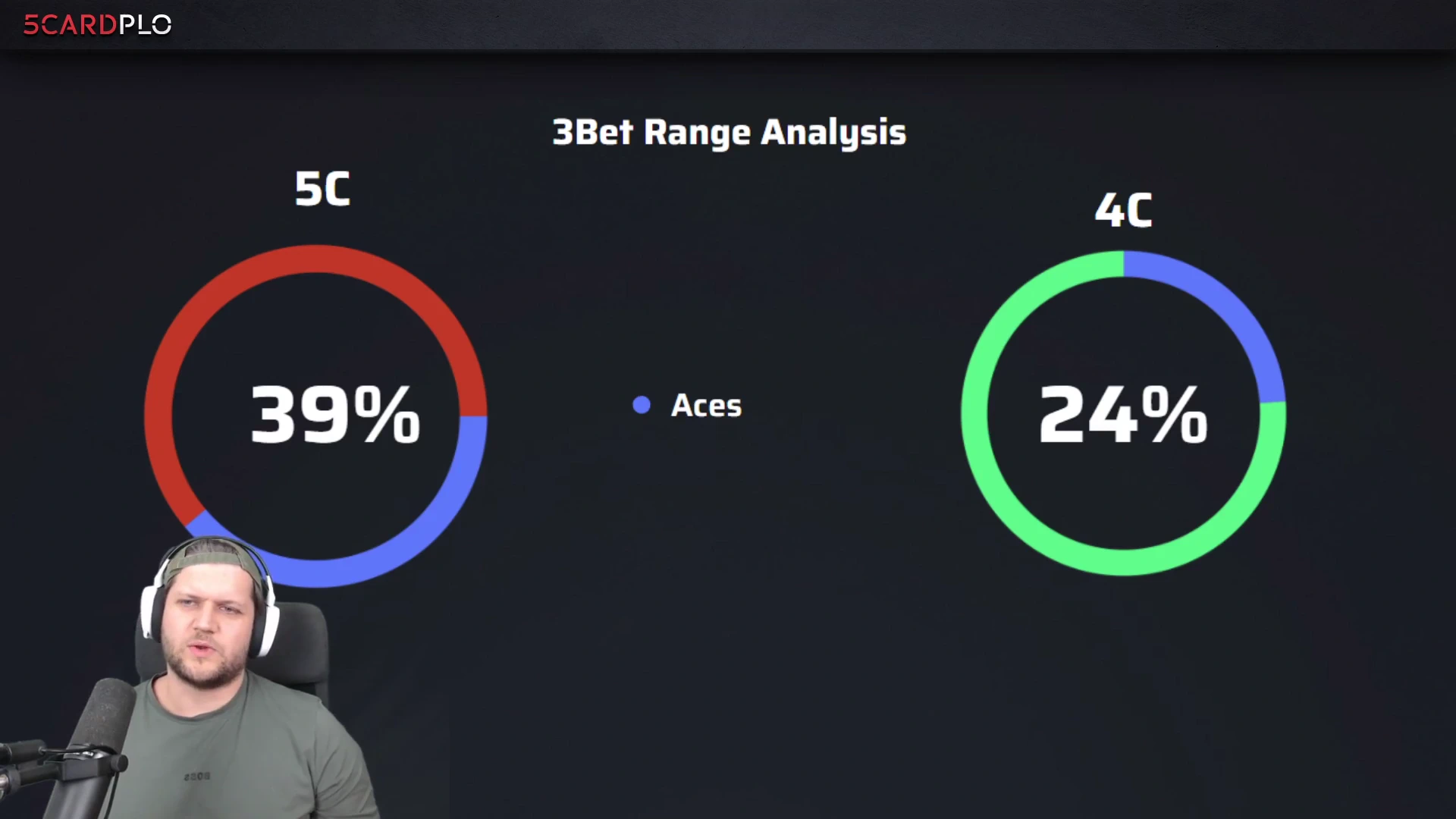
In five-card PLO, aces make up almost 40% of the small blind’s 3-betting range. In four-card PLO the share is about 24%. Four-card 3-bets still include plenty of aces, but they share the range with more kings and more rundowns. Five cards push the range towards aces, and that changes which flops favour the 3-bettor.
~40%
aces in the 5-Card SB 3-bet range
~24%
aces in the 4-Card range
34
flops compared
15
flops where 5-Card checks 15+ pts more
The button’s side moves too. With five cards, the caller simply holds more hands that can continue: top pair with a double gutshot, wraps, two pairs and sets show up far more often. A stronger 3-betting range meets a stickier calling range, and both effects pull the strategy in the same direction on ace-high flops and the opposite direction elsewhere. If you want the preflop side of this spot first, see our guide to PLO blind 3-bet strategy and polarity.
Flop type 1
Ace-High Flops in 4-Card vs 5-Card PLO
Where five-card PLO rewards the 3-bettor even more.
Ace-high boards are where the 4-Card vs 5-Card PLO gap favours the 3-bettor most. They are his best friend in both formats, but in five-card PLO they get even better. Across the seven ace-high flops in the data, the 5-Card checking frequency is about 4%, against 12% in 4-Card, and the pot-size bet rises from an average of 27% to 46% of the range.
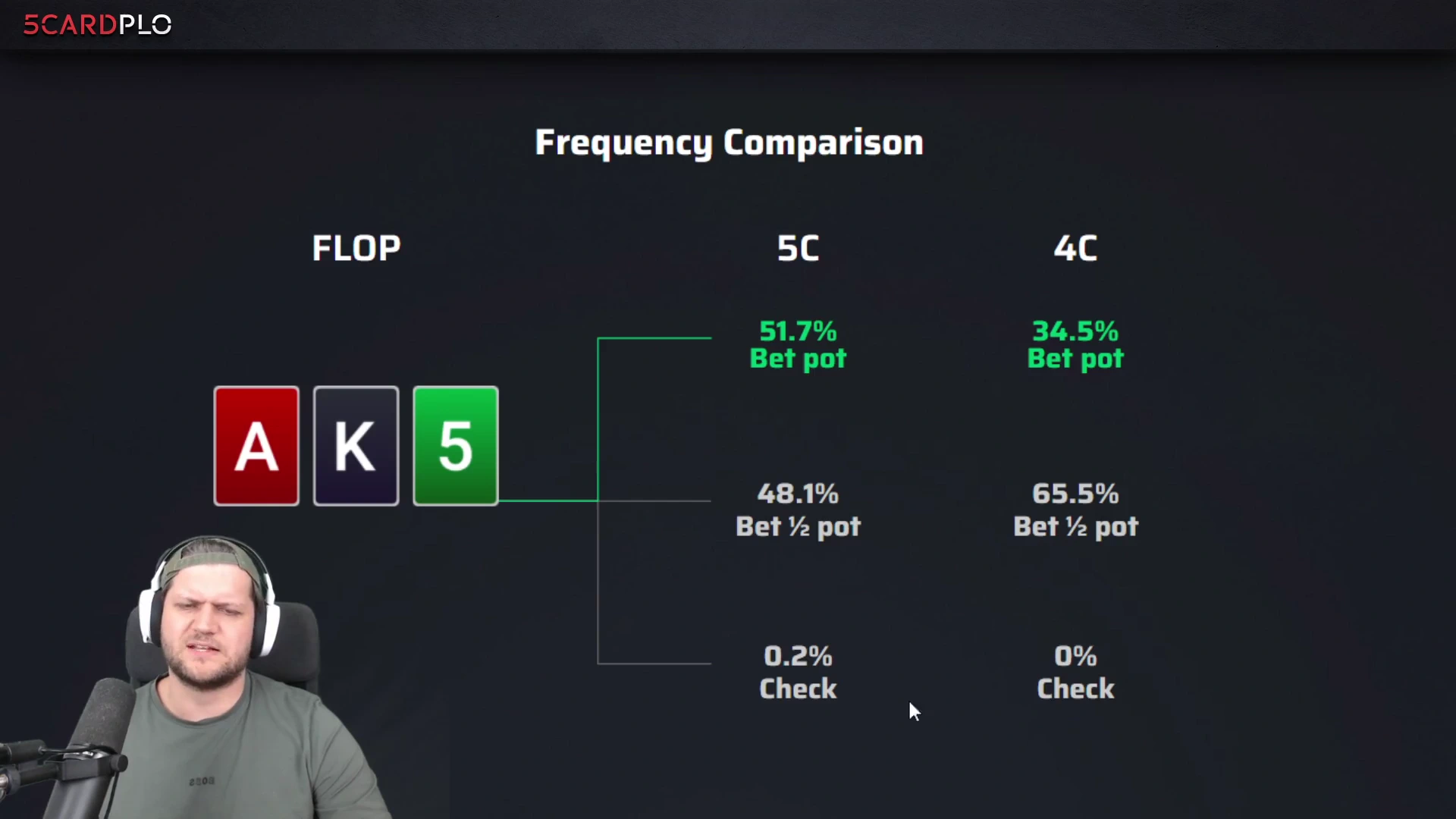
On A-K-5 rainbow the out-of-position player never checks in either game. The difference is sizing: in five cards the pot-size bet is used a little over half the time, against about a third in four cards. Suhepx gives two reasons. The 3-bettor holds more aces and more strong hands, and the button has more hands that can keep calling, so the big bet gets paid more often.
The board most 4-Card players misplay
On A-6-5 two-tone, four-card PLO wants the 3-bettor to check about 35% of the time, because plenty of kings, double-suited queens and high rundowns missed and need a protected checking range. In five-card PLO the same flop is checked only 9% of the time. The common four-card leak is betting every strong hand and then check-folding the kings.
| Ace-high flop | Check (4C → 5C) | ½ pot (4C → 5C) | Pot (4C → 5C) |
|---|---|---|---|
| AK5r | 0% → 0% | 66% → 48% | 34% → 52% |
| AQ9s | 0% → 0% | 49% → 30% | 51% → 70% |
| AJ7s | 0% → 0% | 65% → 33% | 35% → 67% |
| AT9s | 0% → 0% | 69% → 48% | 30% → 52% |
| A65s | 35% → 9% | 30% → 38% | 35% → 53% |
| A54r | 46% → 16% | 54% → 84% | — → — |
r = rainbow, s = two-tone. “—” means the sizing was not part of the solution on that board.
Flop type 2
Broadway Flops in 4-Card vs 5-Card PLO
Boards that were “bet everything” in four cards become checking boards in five.
This is where 4-Card vs 5-Card PLO strategy splits. King-, queen- and jack-high flops are often excellent for the four-card 3-bettor, who holds aces plus kings and broadway hands like A-K-Q and A-K-J. In five cards, those same boards hit the button’s range hard: kings that opened and called, wraps, two pairs and sets.
K-J-6 rainbow is the clearest example. In four-card PLO the 3-bettor never checks and bets half pot almost every time, a simplification most regulars already use. In five-card PLO the checking frequency jumps to 45%. A hand like A-A-K-T-7 is fine on this board, but it is not something to build a big pot with into a range that strong.
Chart · Checking frequency, SB vs BU 3-bet pot
4-Card PLO 5-Card PLO
KJ6r
4-Card 0% · 5-Card 45%
KQ8s
4-Card 5% · 5-Card 46%
KT9r
4-Card 39% · 5-Card 73%
K63r
4-Card 29% · 5-Card 56%
QT7r
4-Card 15% · 5-Card 47%
J82r
4-Card 2% · 5-Card 37%
J53r
4-Card 16% · 5-Card 46%
A65s
4-Card 35% · 5-Card 9%
Source: solver frequencies from the PLO Mastermind lesson data (5-Card PLO Trainer development build vs 4-Card PLO Trainer).
J-8-2 rainbow tells the same story: 2% checking in four cards, 37% in five, with the rest split between 18% half-pot and 45% pot. Over all 17 king-, queen- and jack-high flops in the sheet, the 5-Card checking frequency averages 52%, against 28% in 4-Card. Most of that extra checking comes out of the small bet: on these flops the half-pot frequency falls from about 49% to 30%, while the pot-size bet slips only from about 23% to 18%.
Flop type 3
Low Flops in 4-Card vs 5-Card PLO
Small changes in checking, big changes in sizing.
On ten-high and lower flops, 4-Card vs 5-Card PLO frequencies are closer than you might expect. Across the ten flops from T-high down to 5-high, the checking frequency moves only from 52% to 56%. These boards are already awkward for the 3-bettor in four-card PLO: overpairs can pot, but unpaired rundowns miss and need a checking range.
What changes is how aggressively the made hands bet. On T-7-5 rainbow the pot-size bet drops from 62% in 4-Card to 34% in 5-Card, and on T-5-2 two-tone from 41% to 19%. The lesson’s point is that a board you rated as “good for aces” in four cards, such as T-5-2, has to be re-evaluated: in five cards it depends heavily on your side cards and what they block and unblock.
The numbers
4-Card vs 5-Card PLO: The Data Side by Side
Selected flops from the 34-board comparison, SB vs BU 3-bet pot, out-of-position c-bet strategy.
| Flop | Check (4C → 5C) | ½ pot (4C → 5C) | Pot (4C → 5C) |
|---|---|---|---|
| AK5r | 0% → 0% | 66% → 48% | 34% → 52% |
| AJ7s | 0% → 0% | 65% → 33% | 35% → 67% |
| A65s | 35% → 9% | 30% → 38% | 35% → 53% |
| A54r | 46% → 16% | 54% → 84% | — → — |
| KQ8s | 5% → 46% | 84% → 42% | 11% → 12% |
| KJ6r | 0% → 45% | 97% → 50% | 3% → 5% |
| KT9r | 39% → 73% | 61% → 27% | — → — |
| K63r | 29% → 56% | 39% → 28% | 32% → 16% |
| QT7r | 15% → 47% | 56% → 24% | 29% → 29% |
| Q84s | 24% → 49% | 54% → 31% | 23% → 20% |
| J82r | 2% → 37% | 30% → 18% | 68% → 45% |
| J53r | 16% → 46% | 12% → 8% | 72% → 46% |
| T75r | 33% → 60% | 5% → 6% | 62% → 34% |
| T52s | 17% → 40% | 42% → 41% | 41% → 19% |
| 743r | 92% → 80% | 8% → 20% | — → — |
| 542s | 83% → 69% | 17% → 31% | — → — |
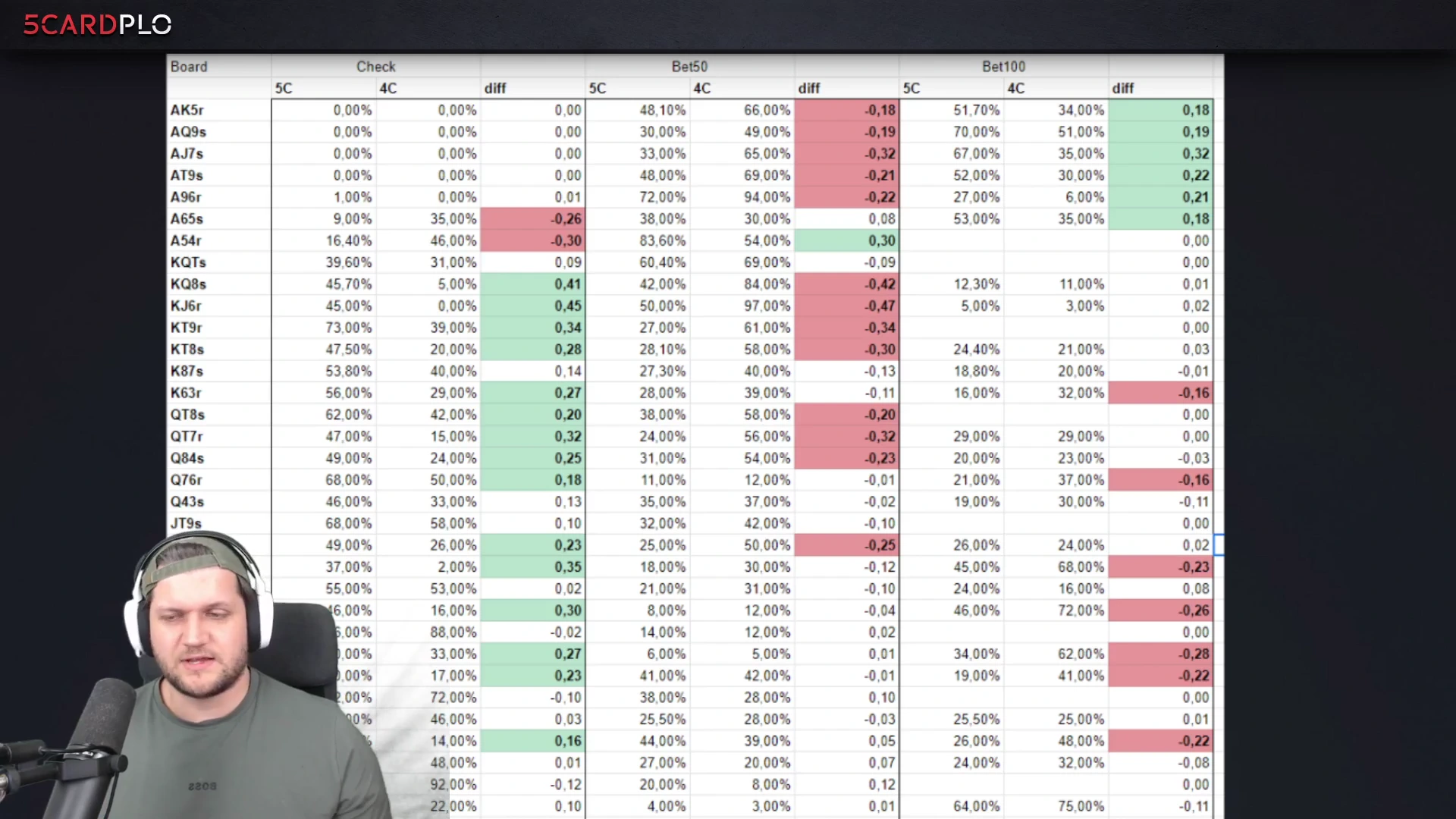
The table shows 16 of the 34 flops in the 4-Card vs 5-Card PLO comparison. Two patterns stand out. In five-card PLO the checking frequency rises by 15 points or more on 15 of the 34 flops, and drops by that much on only two, both ace-high (A-6-5 two-tone and A-5-4 rainbow). On average across all 34 flops, five-card checks 43% of the time against 32% in four-card, uses the half-pot bet less (33% against 43%) and keeps the pot-size bet roughly level.
The numbers come from the development build of the 5-Card PLO Trainer postflop module, which was in testing when the lesson was recorded, compared with the 4-Card PLO Trainer on the same flops. It is a sample of 34 boards, so treat it as a map of tendencies rather than a full solution. The complete sheet, with all 34 flops, is one of the study files in PLO Mastermind 5-Card PLO 2026.
Range protection
Why Balance Matters More in 5-Card PLO
Higher checking frequencies change what a mistake costs.
This is the part of 4-Card vs 5-Card PLO that costs the most money. When a strategy bets almost its whole range, balance hardly matters: you only decide which hands go into the small bet and which into the big one. Once a board needs a real checking range, everything gets harder. You now need hands that check-call, hands that check-raise and a betting range that still holds up.
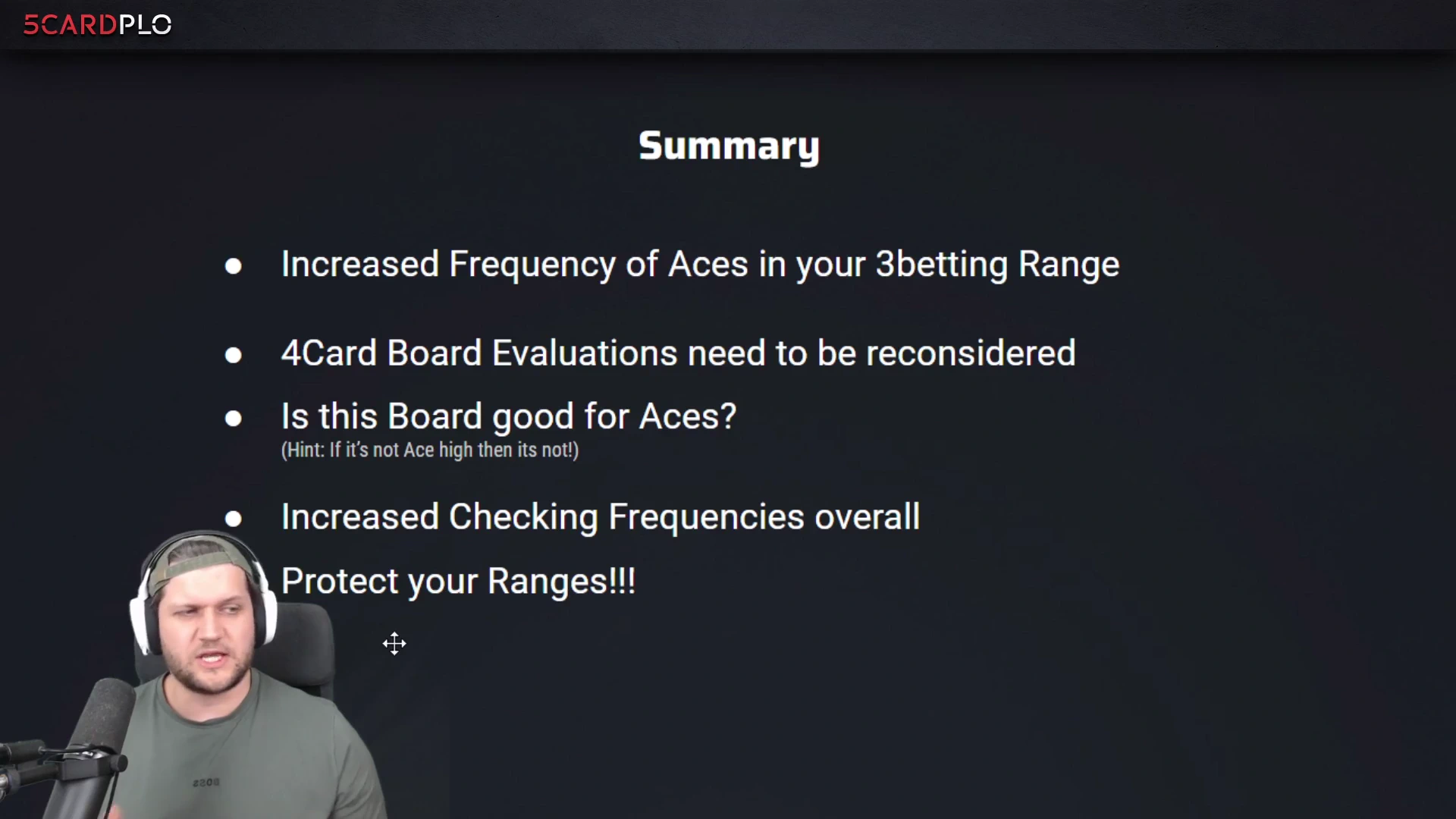
That is the lesson’s final warning. If a spot asks you to check 10 to 15% of the time and your checking range is too weak, good players can exploit it, but you rarely end up there. If a spot asks you to check half the time and you bet every strong hand, you arrive in a capped, foldable range in half of your hands. In five-card PLO that happens on most non-ace-high flops, so slowplaying some sets and top two, and keeping strong hands in the checking range, stops being optional.
For the wider debate on when to play balanced and when to deviate, read our guide to GTO vs exploitative poker.
Cheat sheet
4-Card vs 5-Card PLO: Six Rules to Take to the Table
The lesson condensed into six adjustments you can apply tonight.
Expect more aces
In five cards, about 40% of the SB 3-bet range is aces. Build your c-bet plan around that.
Bet ace-high flops harder
Ace-high flops get checked less and potted more, because the caller has more hands that continue.
Ask “is this good for aces?”
In five-card PLO, a flop without an ace is usually not good for aces, even if it was in four cards.
Build a checking range on broadway flops
Boards like K-J-6 and J-8-2 go from near-zero checking to about 37–45%.
Protect what you check
When you check half the time, include strong hands, check-raises and some slowplays.
Re-test old four-card habits
Low flops change less in checking but much more in pot-size betting. Check your sizing, not just your frequency.
Test yourself
Quick Quiz: 4-Card vs 5-Card PLO
Four questions based on the data above. Tap a card to see the answer.
Q1. Roughly what share of the small blind’s 3-betting range is aces in 5-Card PLO? A) About 24% · B) About 40%Tap to reveal the answer
B. About 40% in five-card PLO, against about 24% in four-card PLO.
Q2. On K-J-6 rainbow, how often does the 5-Card 3-bettor check? A) Never · B) About 45% of the timeTap to reveal the answer
B. Four-card checks it 0% of the time; five-card checks about 45%.
Q3. On A-6-5 two-tone, which format checks more? A) 4-Card, about 35% · B) 5-Card, about 35%Tap to reveal the answer
A. Four-card checks about 35%, five-card only 9%, because the five-card range is so ace-heavy.
Q4. Across all 34 flops, what happens to the average checking frequency in 5-Card? A) It rises from about 32% to 43% · B) It fallsTap to reveal the answer
A. It rises by about 11 points, driven mostly by king-, queen- and jack-high flops.
Go deeper
Where to Study 4-Card vs 5-Card PLO
The lesson comes from PLO Mastermind; here is how the two 2026 courses compare.
| Feature | PLO Mastermind 4-Card PLO 2026 | PLO Mastermind 5-Card PLO 2026 |
|---|---|---|
| Video files | 370 | 431 |
| Runtime | 203 hours | 228 hours |
| 3-bet pot lessons | 27 in the 3-Bet Pots folder | 32 in the 3-Bet Pots folder |
| Includes this comparison lesson | — | ✓ with the 34-board sheet |
| Coaches | 10 + 1 guest | 6 |
| License type | FOREVER LICENSE | FOREVER LICENSE |
Play both formats and want the full 4-Card vs 5-Card PLO picture? The 5-Card PLO 2026 course contains this lesson and the sheet, while the 4-Card PLO 2026 course covers four-card 3-bet pots in depth. Full breakdowns: 5-Card review and 4-Card review. To compare schools, start with the best PLO courses of 2026.
Want the full 34-board sheet?
It comes with PLO Mastermind 5-Card PLO 2026: a FOREVER LICENSE, files sent personally by our team after payment.
Questions
FAQ: 4-Card vs 5-Card PLO
Short answers to common questions about this spot.
What is the biggest difference in 4-Card vs 5-Card PLO 3-bet pots?
Range composition. About 40% of a small-blind 3-betting range is aces in five-card PLO against about 24% in four-card, so ace-high flops get bet harder and most other flops need a much bigger checking range.
Should I c-bet my whole range in 5-Card PLO 3-bet pots?
Only on ace-high flops, where the out-of-position player almost never checks. On king-, queen- and jack-high flops the checking frequency averages about 52% in the data, so range-betting is a clear mistake there.
Are low flops very different between 4-Card and 5-Card PLO?
Less than broadway flops. On ten-high and lower flops the checking frequency moves only from about 52% to 56%, but pot-size betting drops sharply on boards like T-7-5 and T-5-2.
Where does the data come from?
From a PLO Mastermind lesson by Suhepx comparing the 5-Card PLO Trainer postflop development build with the 4-Card PLO Trainer on 34 flops in a small blind vs button 3-bet pot.
Which course should I study for 5-Card PLO 3-bet pots?
PLO Mastermind 5-Card PLO 2026 includes this lesson, the 34-board sheet and 32 videos on 3-bet pots. It is sold with a FOREVER LICENSE; digital files. Crypto payment only. Fast delivery is handled manually after payment confirmation. Download links remain available for 7 days; save your files locally.
FOREVER LICENSE
Study five cards with the full data.
PLO Mastermind 5-Card PLO 2026 with a FOREVER LICENSE: 431 video files, 228 hours, the 34-board 3-bet pot sheet, one payment and no subscription.
✓ One payment · ✓ Lifetime access · ✓ Sent personally by our team after payment
Keep reading
Related PLO Strategy and Courses
More from the site on PLO strategy and the PLO Mastermind school.
PLO Mastermind 5-Card PLO 2026PLO Mastermind 4-Card PLO 2026PLO Mastermind 6-Card 20265-Card 2026 review4-Card 2026 reviewPLO blind 3-bet strategyBTN vs BB strategyGTO vs exploitative pokerHow to study PLO effectivelyBest PLO courses 2026Cory Mikesell vs PLO TheoryPLO Mastermind collectionPLO poker coursesJNandez coach profileElite Poker Guide home
Courses mentioned in this article
 PLO Mastermind 6-Card 2026
 PLO Mastermind 5-Card 2026€119.99
 PLO Mastermind Bundle – All 11 Courses 2026
 PLO Mastermind 4-Card 2026€149.99