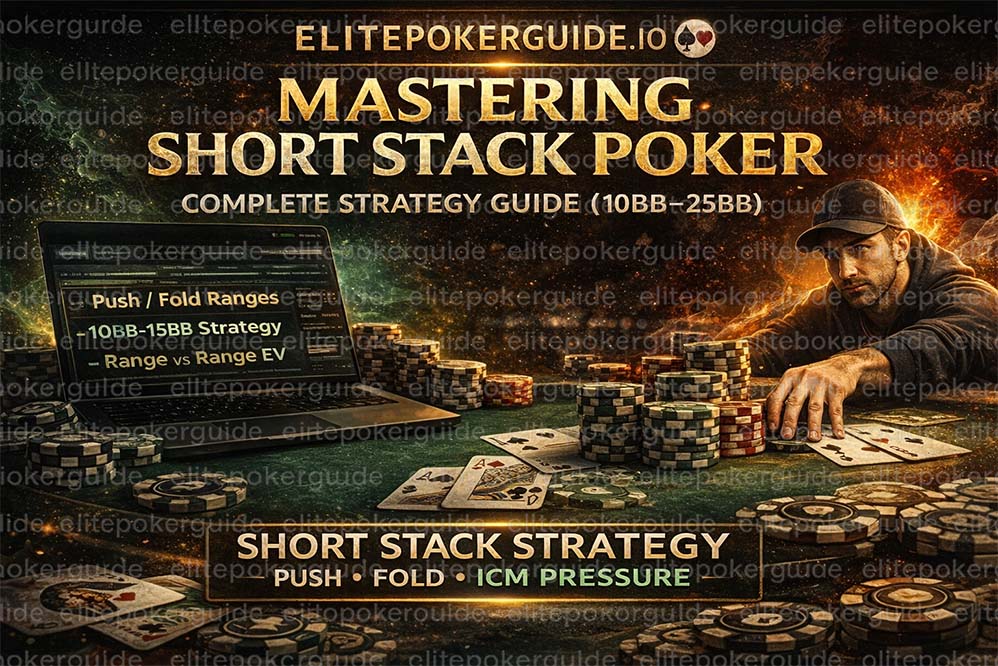
What Is Short Stack Poker and Why It Decides Your Tournament Results
Short stack play is the most misunderstood and most expensive part of tournament poker.
Most players treat 10–25 big blind situations as “survival mode.”
In reality — this is where the majority of EV is either gained or destroyed.
Short stacks are not about folding and waiting.
They are about:push/fold
- Precise aggression
- Range clarity
- Fold equity maximization
- ICM awareness
If you misplay short stack spots, you don’t just lose chips — you lose entire tournaments.
👉 If you want a full ecosystem of tournament training, explore MTT poker courses on https://elitepokerguide.io/product-category/mtt-poker-courses/
👉 Or start from the main hub: https://elitepokerguide.io/
Watch the Full Lesson: Mastering Short Stack Poker
The Core Problem: Why Most Players Fail with Short Stacks
Based on the analytical breakdown and diagnostic materials you provided, the biggest leaks are consistent across all player pools.
🔻 1. Passive Survival Mindset
Players wait too long and blind down instead of applying pressure.
🔺 2. Misunderstanding Fold Equity
They underestimate how often opponents fold in high-pressure spots.
🔻 3. Incorrect Push/Fold Thresholds
Shoving too tight or too wide without understanding stack dynamics.
🔺 4. Fear-Based Decisions
Decisions are driven by “not busting” instead of maximizing EV.
🔻 5. Ignoring ICM Pressure
Players fail to adjust when pay jumps matter.
Short Stack Reality: It’s Not Survival — It’s Controlled Aggression
Short stack poker is not defensive.
It’s one of the most aggressive phases of the game.
When stacks get shallow:
- Ranges widen
- Mistakes increase
- Pressure multiplies
And the player who understands this dynamic dominates.
Stack Depth Breakdown (10BB–25BB)
🟡 20–25BB — The Transition Zone
This is the most complex stack depth.
You can still:
- Open raise
- 3-bet jam
- Apply postflop pressure
But mistakes here are extremely costly.
Key concept:
👉 Your stack is still playable — but fragile
🟠 15–20BB — Pressure Phase
Now the game shifts:
- More reshoving
- More preflop all-ins
- Less postflop play
Critical skill:
👉 Identifying profitable reshove spots vs loose opens
🔴 10–15BB — Push/Fold Optimization
This is where most players collapse.
Correct play requires:
- Understanding Nash baselines
- Adjusting vs population mistakes
- Recognizing stack distribution
Common mistake:
Players shove too tight and lose fold equity value.
For players who want a dedicated short-stack training option, PokerCoaching Mastering GTO Short-Stack Play is one of the most relevant PokerCoaching products to compare. We also included it inside our full PokerCoaching Review, where it fits into the wider MTT and final-table study path: https://elitepokerguide.io/pokercoaching-review/
⚫ Under 10BB — Pure Survival Execution
Now it becomes:
- Maximum fold equity usage
- Correct shove timing
- Position-based aggression
At this stage, hesitation = death.
If you want a broader poker training site for MTT players beyond one short-stack guide, Elite Poker Guide also connects tournament strategy articles with full MTT course categories and reviews.
Reaching the final table completely changes how these short stack decisions work —
especially under extreme ICM pressure where survival becomes more valuable than chip accumulation.
→ See full breakdown: Final Table Poker Strategy: How to Win Under ICM Pressure
The Biggest EV Leak: Push/Fold Errors
From your comparative and methodological guides, one thing is clear:
👉 Most players are losing EV not because they don’t shove —
👉 But because they shove WRONG ranges
Typical Errors:
- Folding profitable shoves
- Calling too wide vs jams
- Ignoring opponent tendencies
- Playing static instead of adaptive ranges
How to Fix Push/Fold Mistakes
Step 1 — Learn Baseline Ranges
You need a default framework (Nash equilibrium).
Step 2 — Adjust vs Population
Most players:
- Call too tight
- Fold too much
👉 This means you should shove wider
Step 3 — Exploit Stack Dynamics
Short stacks vs big stacks behave differently.
Step 4 — Use Pressure as a Weapon
Your stack is not weak — it’s leverage.
The Hidden Factor: Risk Mismanagement
From the diagnostic PDF, one major issue appears:
👉 Players do not understand risk distribution
They:
- Take low EV flips
- Avoid high EV aggression
- Misjudge tournament life value
ICM and Short Stack Strategy
When nearing:
- Bubble
- Final table
- Pay jumps
Short stack play changes completely.
Key Adjustments:
- Attack medium stacks
- Avoid chip leaders without strong hands
- Increase aggression vs tight players
Advanced Concept: Fold Equity Is Your Main Asset
When you’re short stacked, you don’t rely on hand strength.
You rely on:
👉 Fold equity + pressure
That’s why:
- Position matters more
- Timing matters more
- Opponent type matters more
Short Stack Strategy vs Different Player Types
🐟 Weak Passive Players
- Overfold → shove wider
🧠 Regulars
- Balanced → use mixed strategy
🧨 Aggressive Players
- Trap more
- Adjust calling ranges
How This Translates Into Real Profit
If you fix short stack play:
- You survive longer
- You reach more final tables
- You increase ROI dramatically
This is one of the highest leverage skills in tournament poker.
Where to Learn This at a High Level
If you want to go beyond basics and actually dominate short stack play:
👉 Explore advanced tournament systems on
https://elitepokerguide.io/product-category/mtt-poker-courses/
Recommended directions:
- BBZ Poker (ICM + aggression systems)
- Upswing Poker Tournament Track
- GTO Lab MTT Coaching
You can also browse the full library here:
👉 https://elitepokerguide.io/
Internal Linking
Insert links:
- MTT poker courses
- Advanced tournament strategy
- 👉 GTO LAB TOURNAMENT SAVAGERY
- 👉 SAULO COSTA – GTO BLUEPRINT
Final Thoughts: Short Stack = Tournament Control
Most players think:
👉 “I’m short, I’m in danger”
Top players think:
👉 “I’m short, I have maximum leverage”
That difference alone defines winners.
✅ FAQ Schem
❓ What is short stack in poker?
Short stack is typically 10–25 big blinds in tournaments where push-fold and high-pressure decisions dominate.
❓ When should you push all-in with 10BB?
You should push based on position, stack sizes, and opponent tendencies, often using Nash push-fold ranges.
❓ Is push-fold strategy always optimal?
No — it is the baseline. Exploitative adjustments often generate higher EV.
❓ How important is ICM with short stacks?
Critical — ICM heavily impacts correct decisions near the bubble and final table.
 POKERLAB — BRINCAR E EXPLICAR
 POKERCOACHING MASTER HIGH ROLLER FINAL TABLES
 Best Poker Coaching MTT Preflop Automation Tool
 Best Poker Coaching MTT Bronze Course