

Watch: Red Line Poker Explained, inspired by THEJERICHO2
🏆 Key takeaway
Blue + red = green. Your non-showdown winnings are half of your win rate; fix the red line and your results stop depending on the deck. This video is for 100NL–200NL regs who want to move up, not for players happy to stay where they are.
The full system is Run It Once Red Line Mastery, sold with a FOREVER LICENSE: one payment, lifetime access, no subscription. Current offers are on the coupons page.
Key moments
Video Chapters
Jump straight to the part you need.
- 0:00 Intro: the other 50% of your win rate
- 0:19 The graph of 90% of regs
- 1:04 Section 1: the math of winnings
- 1:41 Section 2: three red line myths
- 3:00 Section 3: the mid-stakes wall
- 3:37 Section 4: the GTO foundation
- 4:25 Section 5: the weekly leak fix
- 4:57 Section 6: the next step
Each timestamp opens the video at that moment on YouTube. Below, every section is summarised and matched to the lessons in the full course where thejericho2 goes deeper.
Section 1
Non-Showdown Winnings: Blue + Red = Green
The math behind every poker graph.
The video opens on the graph that, by thejericho2’s estimate, belongs to around 90% of regular online players: a blue line (showdown winnings) that climbs, and a red line (non-showdown winnings) that slides at a punishing 45-degree angle. The green line, your actual profit, is simply blue plus red. If the red line keeps falling, you need to run hot and play perfectly at showdown just to stay afloat.
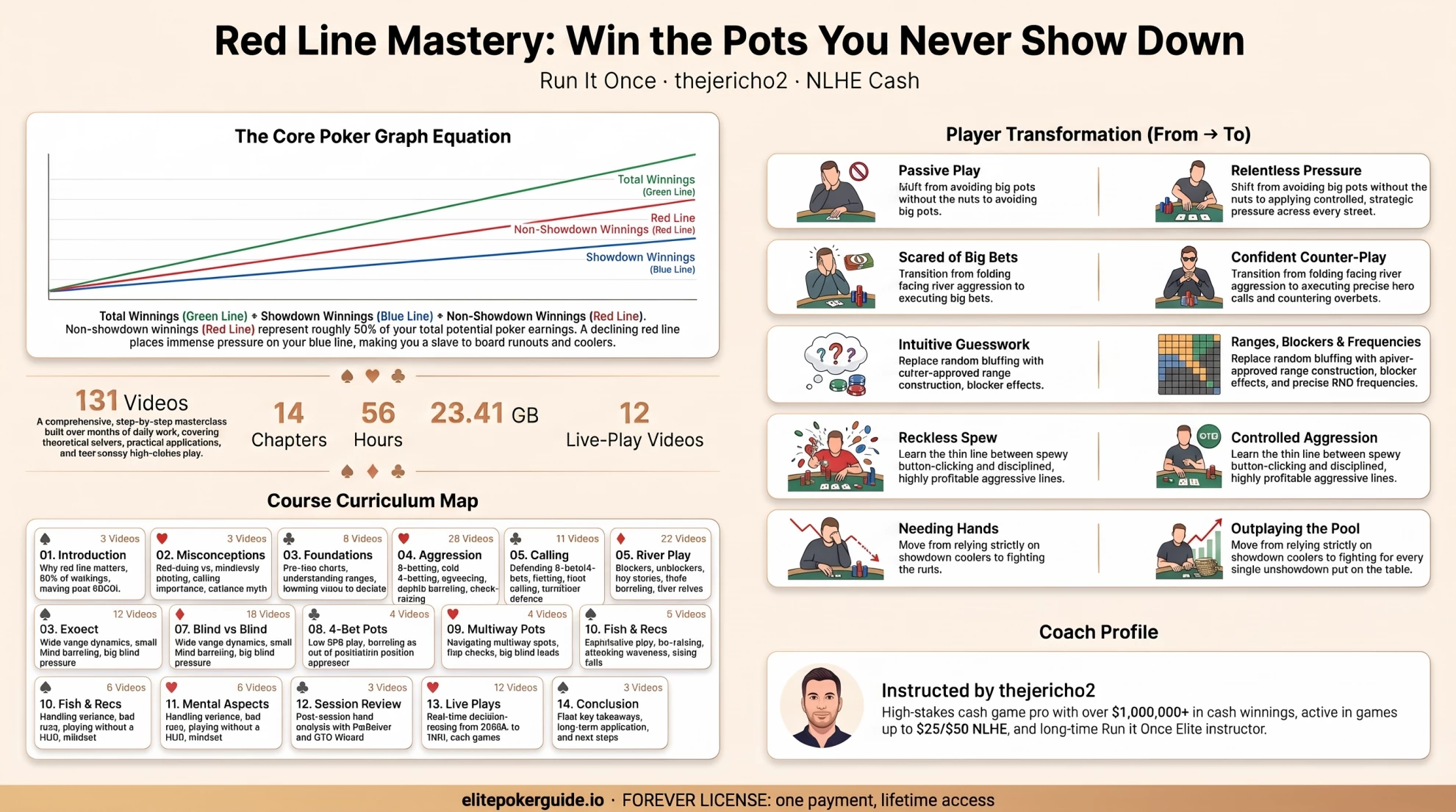
The target is what the course calls the purple line: blue and red both winning. A solver-style strategy fights for pots and collects dead money without needing to see a river, and that is the graph the course is built to move you towards.
“So it’s basically 50% of your winnings.”
— thejericho2, Red Line Mastery lesson 1.1
Inside the course
Lesson 1.1 Why Is Having a Winning Red Line Important? (9:42) and 1.2 What Does Having a Winning Red Line Do to Your Overall Game? (17:25). For the theory side, see our blue line vs red line vs green line breakdown.
Section 2
Three Red Line Myths
The beliefs that keep players stuck in a passive, blue-line-only game.
01
Myth
Red line players always bluff
They don’t. Bluffing matters, but without a system for frequencies, aggression turns into spew. Lesson 2.1, 11:10.
02
Myth
Calling doesn’t move the red line
It does. Folding is how the red line drops, so better calls protect it. Lesson 2.2, 5:01.
03
Myth
Red-lining means more variance
The course argues the opposite: winning pots without showdown keeps the graph afloat when you are not making hands. Lesson 2.3, 11:50.
The key insight
Folding is the leak
A call that goes to showdown lands on the blue line. A fold costs you on the red line every time. That is why the course gives calling its own 11-video chapter.
The variance myth gets the most attention in the video, and it comes straight from the coach’s own career: as a showdown-heavy player, he describes being “a slave to the board”, winning only when he made hands. The full story is in our thejericho2 poker coach profile.
Section 3
The Mid-Stakes Wall: Why MDA Stops Working
Why a strategy that prints at 100NL stalls at 500NL.
A showdown-heavy game, or one built on simple population exploits from mass data analysis (MDA), can work comfortably up to around 200NL, where players overfold. The video’s point is that this stops at 500NL: the player pool is smaller and sharper, opponents notice one-sided exploits, and by 1kNL the meta keeps evolving. Without a balanced, solver-based baseline, you get played back.
Inside the course
Lesson 1.3 Why Not Just Rely on Blue Line Winnings or MDA? (8:16). For how MDA exploits work where they still pay, read our MDA and HUD exploit guide.
Section 4
The GTO Foundation
What to fix before you add aggression.
Before you add aggression, the video lists the groundwork: know your preflop charts so your ranges are anchored, know where you are in your range after the flop, put in real solver study, and stop autopiloting the small pots.
“When you know GTO, that’s when you can deviate.”
— thejericho2, Red Line Mastery lesson 1.1
Without a baseline you aren’t exploiting anyone, you are guessing. That is the reason the course spends a whole chapter on preparation before the first aggression lesson.
Inside the course
Chapter 03 Work Before Becoming a Red Line Player: 6 videos, 1h 48m, from Knowing Your Preflop Charts (32:20) to Be Willing to Put the Money In (14:53). Solver habits: how to use PioSOLVER in real games.
Section 5
The Weekly Leak Fix
A four-step loop you can start this week.
Inside the course
The routine comes from the course’s final lessons and its review chapter: 14.3 Am I Still a Nit? (6:25), where the coach’s example is a week spent only on flop check-raises, and chapter 12 Session & Hand Review Advice (3 videos, 2h 09m), which shows the same process in Holdem Manager 3, PioSOLVER and GTO Wizard.
Section 6
The Next Step: Master Your Red Line
Where the video ends, the course begins.
The video is a six-minute doorway. The complete system is Run It Once Red Line Mastery by thejericho2, a high-stakes cash pro and long-time Run It Once Elite instructor.
131
videos
14
chapters
56
hours
12
live plays, 200NL–1kNL
It covers preflop, flop and turn aggression, calling, a 22-video river chapter, 18 blind vs blind lessons, 4-bet and multiway pots, exploits against weaker players, the mental game and solver review routines. Before you buy, read the full lesson list with every runtime in our Red Line Mastery index review.
Ready to fix your non-showdown winnings?
Red Line Mastery comes with a FOREVER LICENSE: one payment, lifetime access, files sent personally by our team after payment.
Digital files. Crypto payment only. Fast delivery is handled manually after payment confirmation. Download links remain available for 7 days; save your files locally.
Keep learning
Watch and Listen Next
Two more ways to study the red line.
Listen: the 30-minute deep dive into the same course is Elite Poker Guide Podcast Episode 08, Fix Your Poker Red Line. It goes further into the coach’s story, the calling side of the red line and the mental game.
Watch next: our earlier Red Line Poker Explained video compares four red line courses side by side; the full written comparison is in the best red line poker courses.
FAQ
Non-Showdown Winnings FAQ
Quick answers to the questions behind the video.
What are non-showdown winnings in poker?
Money you win or lose in pots that end before showdown: bluffs that get folds, and pots you give up by folding. In tracking software they are shown as the red line; showdown winnings are the blue line, and the two add up to your total winnings, the green line.
What is the purple line?
The name used in Red Line Mastery for a graph where both the blue line and the red line are winning. The course treats it as the closest a human graph gets to how a solver plays.
Why does a showdown-heavy style stall around 200NL?
According to the course, players at lower stakes overfold, so a tight, showdown-first or MDA-driven game wins. From 500NL up, the pool is smaller and sharper, opponents adapt to one-sided exploits, and you need a solver-based baseline.
Who is thejericho2?
A high-stakes NLHE cash pro and long-time Run It Once Elite instructor who has played up to NL5K. See the thejericho2 poker coach profile.
FOREVER LICENSE
Stop bleeding your red line.
The video is six minutes. Red Line Mastery is 131 videos and 56 hours on every street. Subscriptions expire; a FOREVER LICENSE never does.
✓ One payment · ✓ Lifetime access · ✓ Sent personally by our team after payment
Related
Elite Poker Guide home
Red Line Mastery
Red Line Mastery index review
thejericho2 poker coach
Run It Once courses
Cash game courses
Saulo Costa The Redline Blueprint
Robmaf Redline Ninja
Elite Poker Guide podcast
Courses mentioned in this article
 Run It Once Red Line Mastery€149.99
 SAULO COSTA DOSE OF RED LINE 2026
 Run It Once Red Line Mastery
 Run It Once Elite NLHE Poker Training 2023 Complete