Most players think tilt is the guy smashing his mouse after a bad beat. It isn’t. Tilt is any decision you make because of an emotion instead of your best strategic thought — and by that definition, you’ve tilted today, whether you noticed it or not.
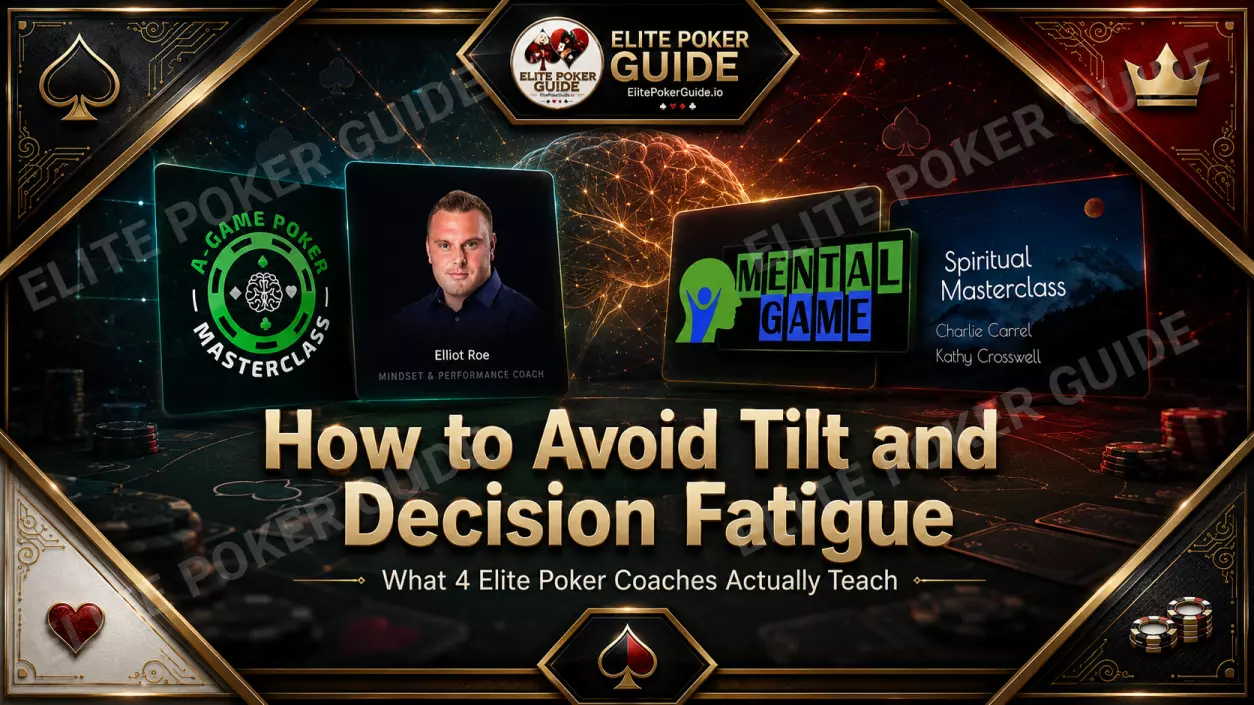
To avoid tilt and decision fatigue, you first need a definition that actually holds up under pressure — not the cartoon version everyone laughs about on forums. We pulled apart the full transcribed curriculum of four mental game courses — Elliot Roe’s A-Game Poker Masterclass, Gordon’s Tilt-Free Today, Charlie Carrel’s Epiphany Masterclass, and Nick Howard’s Mental Game Pack — looking specifically for where these four coaches agree, where they disagree, and what that tells you about actually fixing this leak instead of just naming it.
🏆 Quick Verdict
Tilt isn’t a personality flaw — it’s a mechanical process (trigger → emotion → action) that you can interrupt at any of three points. All four coaches below teach a version of that interruption, and all four courses are available with a FOREVER LICENSE at ElitePokerGuide.io. For a full course-by-course breakdown, see our Best Mental Game Poker Courses 2026 guide. Check the coupons page for today’s active discount.
📚 How This Guide Was Built
Every technique and concept described in this guide was pulled directly from the full video content of the four courses below — not from marketing copy, press releases, or generic “mental game” clichés recycled from other blogs. We reviewed every lesson listed on each product page before writing a single word.
- Elliot Roe — A-Game Poker Masterclass (Run It Once)
- Gordon — Tilt-Free Today (BestPokerCoaching)
- Charlie Carrel & Kathy Crosswell — Epiphany Masterclass
- Nick Howard — Mental Game Pack (Poker Detox)
We describe what each coach teaches in our own words — we don’t reproduce their lessons verbatim. If a technique here resonates, the full lesson is waiting inside the course itself, available with a FOREVER LICENSE on ElitePokerGuide.io.
Why Tilt Isn’t What You Think It Is
Elliot Roe, the performance coach behind Run It Once’s A-Game Poker Masterclass, gives the cleanest working definition in any mental game course we’ve reviewed: tilt is any time you deviate from your best strategic decision because of emotion — good or bad. That last part trips people up. Winning a huge pot and suddenly widening your ranges out of overconfidence is tilt by this definition, exactly as much as steaming after a bad beat. The visible, chair-throwing version is just the extreme end of a spectrum most players are somewhere on every session.
Underneath that definition sits a simple three-step mechanism: trigger, emotion, action. Something happens (a trigger — a bad beat, a comment, an internal thought), it produces a feeling (fear, anger, overconfidence), and then you act on it. Tilt only exists at that third step. You can be triggered, feel the emotion, and still not act on it — and that’s the entire game. Every technique below is really just a different way of intervening between step two and step three.
This matters because it reframes the whole problem. You can’t stop triggers from happening — bad beats, weak players getting lucky, and 3-bets from the same aggressive reg are just part of the game, whether you’re grinding GGPoker, PokerStars, or 888poker. What you can train is the gap between feeling something and acting on it.
4 Reframe Techniques Elite Coaches Actually Teach
1. The Control Room (Elliot Roe)
Picture your mind as a control room with a dial labeled with whatever you’re feeling — anger, fear, tilt — set from 1 to 10. Roe’s technique is to consciously visualize turning that dial down a notch at a time, checking in with how each drop actually feels. It doesn’t erase the emotion, but it builds the habit of treating emotions as something you’re observing and adjusting, rather than something that’s driving you.
2. “I Am the Casino” (Elliot Roe)
When a weak player sucks out on you, Roe’s reframe is to picture yourself as the house running a roulette wheel. The casino doesn’t get angry when someone hits their number on 00 — the staff smiles, because they know the math works out over the long run. Reframing a bad beat as “the house getting unlucky on one spin” instead of “an injustice” targets the emotion directly instead of trying to argue yourself out of it after the fact.
3. The Graph on the Wall (Charlie Carrel)
Carrel’s approach leans spiritual rather than clinical, but the mechanism is the same distance-creation. His suggestion: print your full lifetime results graph and hang it where you play. When you’re down a few hundred dollars in a session, look at the graph showing tens of thousands in career profit. The technique works by widening your window — from “this session” to “this career” — so a normal downswing stops registering as a threat.
4. Challenge the Assessment, Not the Emotion (Nick Howard)
Howard’s Mental Game Pack takes a different angle entirely: instead of managing the emotion once it’s triggered, question the belief that created it. A player convinced he’s “blocked” at a certain stake has already made that block real to himself before any hand is dealt. Howard’s method is to trace the belief back to its root — usually a period of pain or a downswing — and challenge whether it was ever objectively true, rather than soothing the feeling it produces.
None of these four techniques contradict each other — they intervene at different points. The control room and casino reframes work in the moment, mid-session. The graph-on-the-wall technique works at the start of a session, before you sit down. Howard’s belief-challenge works away from the table entirely, as study work. A complete system, like the one built into the A-Game Poker Masterclass, actually stacks versions of all three timeframes together rather than picking one.
Why Variance Is a Trainable Skill, Not a Mood
Gordon, the coach behind BestPokerCoaching’s Tilt-Free Today, spends an entire module on the gambler’s fallacy — the belief that because you’ve run bad recently, you’re somehow “due” to run good. It’s not a fringe idea; it’s the default way most human brains process randomness, and poker punishes it constantly. Gordon’s course treats tilt-proofing as a trainable muscle rather than a fixed trait: you build a habit of quitting on a pre-set signal the same way you’d build any physical habit, through repeated small reps rather than willpower in the moment.
Carrel makes a related point from a completely different direction: he describes deliberately underestimating his winnings mid-session, so that finding out he’d actually won more than he thought became a small positive surprise rather than a letdown. Same instinct as Gordon’s stop-loss habit — build the buffer before you need it, not during the moment you’re already tilted.
Fix the Leak Between Your Ears
All 4 courses covered in this guide are available now with a FOREVER LICENSE — no subscription, own it forever.
The Real Cost of Decision Fatigue
Roe’s A-Game framework names three “decision destroyers” that degrade play before any specific emotional trigger even fires: low energy, high stress, and emotion itself. Of the three, low energy is the one players notice least, because it doesn’t feel dramatic — it just quietly lowers the bar for what counts as “good enough” to act on. A tired brain reaches for the easiest decision, not the best one.
This tracks with what’s known more broadly about decision fatigue outside of poker. One widely cited study tracked Israeli parole board judges across a day of back-to-back rulings and found approval rates drifting downward as each decision session wore on, recovering sharply after a food break — a pattern later researchers have debated the exact cause of, but which fits the general, well-supported idea that decision quality drifts under sustained cognitive load. Replace “parole rulings” with “river folds in hour six of a session” and the mechanism Roe describes lines up.
This is exactly why Roe builds mental pit stops and a full post-session routine into the A-Game curriculum instead of treating recovery as an afterthought — decision fatigue isn’t solved by willpower, it’s solved by scheduled recovery, the same way physical fatigue is solved by rest rather than by trying harder.
Which Course Goes Deepest on This
If tilt and decision fatigue specifically are your leak, the A-Game Poker Masterclass covers the most ground — trigger-emotion-action, in-the-moment reframes, and full recovery architecture in one system. Gordon’s Tilt-Free Today is the fastest, most beginner-friendly entry if you just need concrete quitting rules today. Carrel’s Epiphany Masterclass is the deepest option if variance and burnout are affecting you outside poker too. Nick Howard’s Mental Game Pack is built for players who want to question the beliefs sitting underneath the emotion, not just manage the emotion itself.
For the full side-by-side breakdown — lesson counts, content length, and scoring across all four — see our Best Mental Game Poker Courses 2026 guide. Paying retail for a comparable structured tilt program elsewhere means overpaying for concepts you can own outright, with a FOREVER LICENSE, here. All four are part of our wider cheap poker courses catalog, and pair naturally with the technical side of the game covered in our best poker training sites guide — check today’s active coupon before you buy.
Listen & Watch
Prefer audio or video? We’ve built a companion podcast episode and video walkthrough covering this same material from a different angle.
FAQ
What is the actual definition of tilt in poker?
Elliot Roe’s definition, used throughout the A-Game Poker Masterclass, is any deviation from your best strategic decision caused by emotion — whether that emotion is negative (anger, fear) or positive (overconfidence after a big win).
How do I avoid tilt and decision fatigue during a long session?
Build in scheduled mental pit stops rather than waiting until focus is already gone, and use a pre-set quitting signal (a stop-loss, a time limit) rather than deciding in the moment whether to keep playing — decisions made while already fatigued tend to be worse decisions.
Is the gambler’s fallacy the same thing as tilt?
They’re related but distinct. The gambler’s fallacy is the false belief that you’re “due” for a change in variance; tilt is the emotional decision-making that often follows once that belief takes hold.
Can meditation actually help with poker tilt?
Multiple coaches in this guide use meditation as one tool among several, not a standalone fix. It appears to help most with the distancing step — separating “I feel angry” from “I am angry” — which is the same mechanism behind several non-meditative reframe techniques covered above.
What is a FOREVER LICENSE?
A one-time payment that gives you permanent access to a course, with no recurring subscription and no expiration. Every course covered in this guide ships with a FOREVER LICENSE at ElitePokerGuide.io.
Which mental game course is best for beginners?
Gordon’s Tilt-Free Today is built specifically as a beginner-friendly, fast entry point with concrete exercises rather than a long structured curriculum.
Your Next Session Starts Before You Sit Down
Every course in this guide is live now on ElitePokerGuide.io with a FOREVER LICENSE and a one-time price.
Updated: August 2026. Concepts and techniques in this article were compiled directly from the full transcribed curriculum of each course. Written by the ElitePokerGuide.io editorial team.
 Curso Gran Master de Descartes Póker
 Curso Masters de Descartes Póker
 Curso GG Poker de Descartes Póker
 Curso BluffCatching System – Descartes Póker