
Your solver has never seen a pulse. It has never watched a man count out calling chips and then reach for more. It does not know that the player in seat four flew across an ocean to be here.
Updated September 2026 · Live poker tells, timing reads and player profiling for tournament players · ElitePokerGuide.io
💡 The short version: solver study gives you a baseline. Live poker tells give you the deviation. A player who only has the first is playing a version of the game that exists nowhere outside a screen. This guide breaks live reads into four layers you can actually train — pre-hand profiling, timing, physiology, and the trap that catches most students who learn tells badly.
Why Your Solver Is Blind to Live Poker Tells
Before we get to the live poker tells themselves, it is worth being precise about what a solver does. It answers one question with total authority: what is the game-theory optimal action given this range, this board, this stack depth. It is the most powerful study tool tournament poker has ever had. It is also, by construction, an opponent-free model. It assumes the player across from you is playing perfectly. It has no input field for the fact that he has been awake for nineteen hours, that he just lost a flip on the feature table, or that his hands were steady on the flop and are not steady now.
That gap is not a small one. In a live tournament field, a meaningful share of your edge comes from opponents who deviate from equilibrium in patterned, readable ways. Solver work tells you what the correct default is. Live poker tells tell you when to abandon it — and abandoning the default at the right moment is where the money actually sits.
The honest difficulty is that live reads have historically been taught badly. The classic example sits in Run It Once’s own library. In the Live Tells video from their WSOP Prep path, the coach opens by admitting that almost all of his live reads are made in the moment and are very feel-based, that several viewers had already told him this was probably impossible to teach on video, and that a large number of players have tells exclusive to themselves and nobody else. He is being completely honest. He is also describing why an entire generation of players concluded that live poker tells were mystical rather than trainable.
They are trainable. Live poker tells simply have to be broken into layers, and then each layer trained on its own terms.
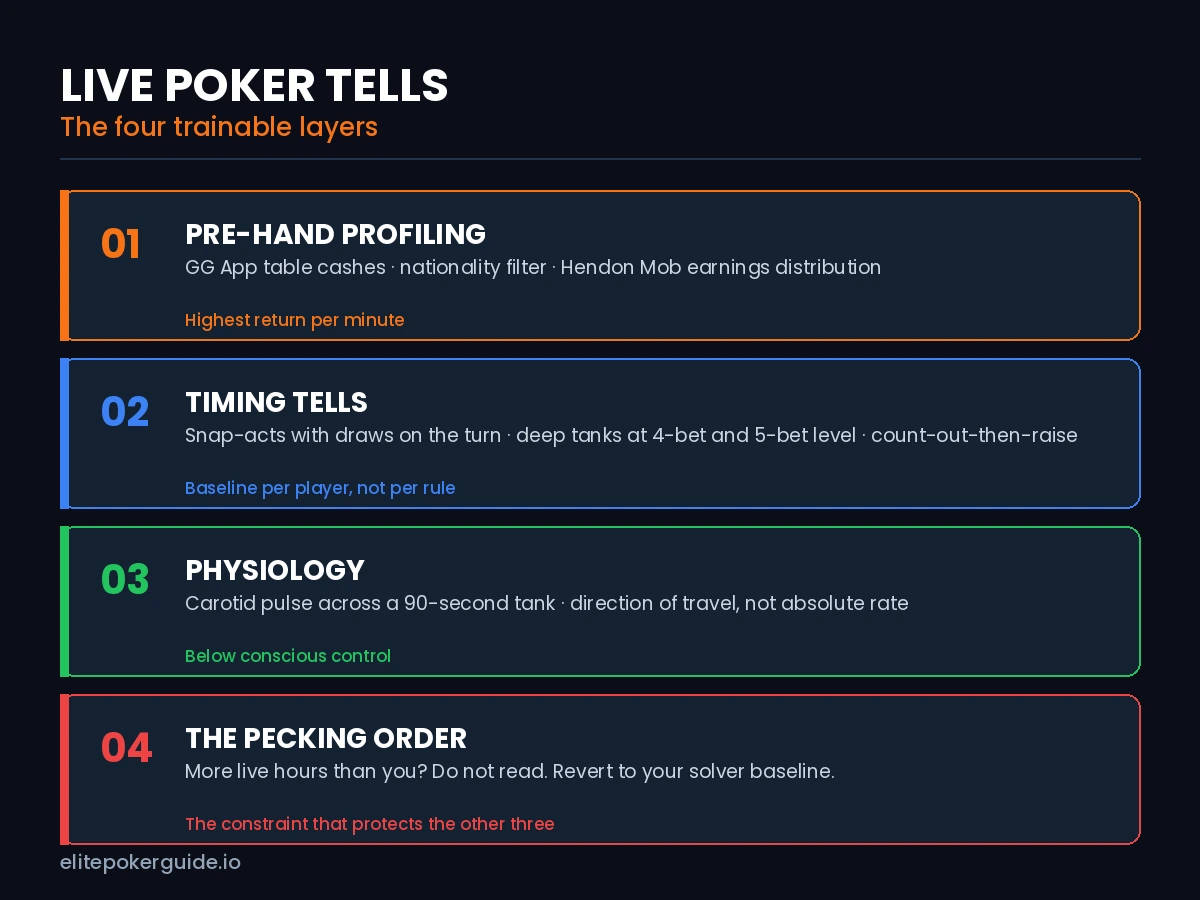
Layer 1 of Live Poker Tells — Profiling Before a Single Card Is Dealt
The first and most reliable layer of live poker tells involves no reading of human beings at all. It is data collection, and most players skip it entirely because it happens before the cards are in the air.
Three objective inputs available to you at a WSOP table
- The GG App. Because GG owns the WSOP, the app shows you everyone at your table alongside their live and online WSOP tournament cashes. That is a direct proxy for average buy-in. You are handed a rough stakes profile of the entire table before the first hand, and most of the table does not look.
- Nationality as a filter. Jonathan Jaffe treats a foreign flag on American soil as the starting point of profiling. The logic is simple and it is about selection, not stereotype: a player who crossed an ocean to enter this event has a high baseline probability of being a dedicated, competent professional. Americans, by contrast, are the population you profile hardest, because the local field is where the recreational money sits.
- The Hendon Mob illusion. This one flips the naive read. Jaffe warns specifically about opponents with enormous total earnings — say $6 million — where a single tournament accounts for nearly all of it. That is not a professional. That is a recreational player who ran extremely well once. The headline figure says shark; the distribution says fish.
None of this requires you to look at anyone’s face. It requires you to do fifteen minutes of work that the rest of your table will not do. This is the highest return-per-minute layer of live poker tells available to a modern tournament player, and it is the layer that did not exist in the era when live reads were being taught as pure intuition.
Layer 2 of Live Poker Tells — Timing, Street by Street
Timing is the most systematic category of live poker tells available to a tournament player, because it produces a measurable signal — elapsed seconds — that you can compare against the same player’s own baseline rather than against some universal rule.
Leon Sturm’s observation on recreational players is a clean starting point: holding a straight or flush draw on the turn, weaker players tend to act fast. They are eager to see the river. The impatience is real and it leaks. Strong players do the opposite — they deliberately even out their timing precisely so their draws are not readable.
Run It Once’s material, older as it is, converges on the same structural idea from a different angle: at the four-bet and five-bet level, good players go deep into the tank with both strong and weak holdings, while weaker players are more theatrical in smaller pots where they are less conscious of what they are giving away. The same source flags a pattern worth committing to memory — a player who counts out calling chips, studies, and then reaches back for more chips to raise is very often holding a strong hand, and the read is at its most reliable on the river.
⚠️ The discipline that makes this work: if opponent timing carries information, so does yours. Balancing your own tempo — taking a consistent few seconds in high-leverage preflop spots regardless of holding — is not paranoia, it is the price of being allowed to use timing reads at all. A player who reads timing but does not manage his own is running a net loss against anyone paying attention.
Layer 3 — Physiology: The Live Poker Tells a Screen Erases
Physiology is the layer of live poker tells that separates live tournaments from every other form of the game, and it is the one no solver, tracker or HUD will ever approximate.
The technique most cited among elite live professionals involves the carotid artery. Facing a difficult river decision, you deliberately extend your tank — ninety seconds, sometimes two minutes — and watch the pulse at your opponent’s neck. The pattern to look for is not the absolute rate but the direction of travel. A value bettor typically starts elevated, because being about to get paid is exciting, and then settles as your tank drags on. A bluffer stays agitated for the full duration, because for him the threat of a call never goes away — and it is common for his rate to climb rather than fall.
Here is the technique explained in full:
The reason this read holds up better than most live poker tells is that it sits below conscious control. A player can rehearse his chip handling, flatten his speech and freeze his posture. Cardiovascular response to sustained threat is not on that list. It is one of the few signals in poker that an opponent cannot decide to stop producing.
The Pecking Order — When Live Poker Tells Work Against You
Everything above becomes dangerous the moment you apply it upward. This is the single most expensive mistake players make with live poker tells.
Jonathan Jaffe teaches a concept he attributes to Dan Smith and calls the Pecking Order. The principle: if your opponent has meaningfully more live table hours than you do, attempting to read his timing is not neutral — it is actively hazardous. He has spent more years than you thinking about what his tempo communicates. The information you believe you are extracting is far more likely to be information he is choosing to hand you.
Jaffe’s Bellagio $10K anecdote is the sharpest illustration of the point. A player spent the session projecting extreme tightness: criticising bluffs, questioning aggressive lines, cultivating the persona of a man who would never get out of line. He then turned up in a large three-bet pot showdown holding two-three offsuit. The entire table read had been constructed on purpose, over hours, for exactly that moment.
The rule that follows from this: apply live poker tells downward and sideways, never upward. Against recreational players and weak regulars, physical and timing reads are among the most profitable tools you own. Against a professional with more live hours than you, revert to your solver baseline and let your technical game do the work. Knowing which opponents you are permitted to read is a bigger skill than the reading itself.
The Prerequisite Nobody Studies: Your Own Hardware
There is a reason this section sits inside a guide about live poker tells rather than in a lifestyle article. Every read described above depends on sustained attention across sessions that run twelve hours and longer. Attention is a physiological resource, and at hour nine you do not lose ten percent of your reading ability — you lose most of it.
Leon Sturm addresses two specific inputs. The first is light: blue-light-reducing glasses are widely used in the high-stakes world to support natural melatonin production and protect sleep quality through a long series, where late finishes and bright rooms wreck circadian rhythm by default. The second is food. He identifies high-carbohydrate meals as a genuine energy trap — the crash and the brain fog that follow are severe enough to cost you real decisions. His practical structure is one substantial meal before play, then only easily digestible snacks during the grind: nuts, yoghurt, fruit.
Treat this as part of your reads training, not adjacent to it. A tired player does not miss tells dramatically. He simply stops looking, and never notices that he stopped. If the mental side of long series is a known weakness for you, our guide to the best mental game poker courses covers the discipline in depth.
Solver Reads vs Live Reads: What Each One Actually Gives You
| Question at the table | Solver study | Live poker tells |
|---|---|---|
| What is my default action here? | Authoritative ✓ | Silent |
| Is this specific opponent a pro or a recreational? | Silent | Answered pre-hand ✓ |
| Is he on a draw right now? | Range-level only | Timing read ✓ |
| Is this river bet value or a bluff? | Frequency, not this hand | Physiological read ✓ |
| Has he built a false image over three hours? | Silent | Detectable with hours ✓ |
| Am I the one being read? | Silent | Pecking Order ✓ |
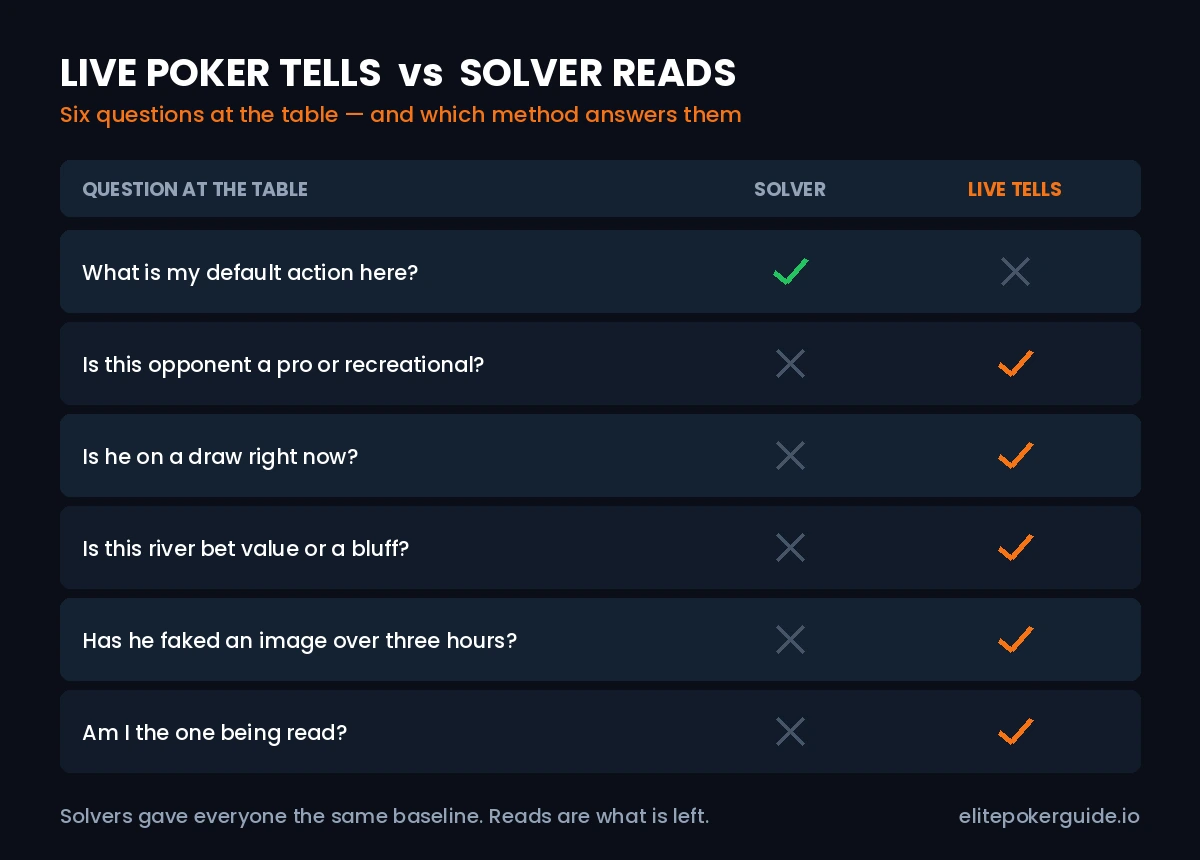
The column that wins depends entirely on the question. Anyone selling you one as a replacement for the other is selling you half a game.
A Four-Week Routine for Training Live Poker Tells
Reading about live poker tells changes nothing. The layers only become usable when each one is drilled in isolation, in order, with a metric attached.
- Week 1 — profile only. No physical reads at all. Before every session, log every opponent you can identify: app data, earnings distribution, nationality, apparent stakes. Judge yourself purely on whether your pre-hand classification held up by the end of the level.
- Week 2 — timing baselines. Pick two opponents per session and track only their tempo, on hands you are not in. You are building a personal baseline for each, not applying a rule. Deviation from a player’s own norm is the signal; absolute speed is noise.
- Week 3 — physiology on one street. Restrict yourself to river decisions where you already intend to tank. Watch breathing and neck pulse. Record your prediction before you act, then check it at showdown. Prediction accuracy is the only metric that matters here.
- Week 4 — your own leakage. Have someone watch you, or record your own sessions if the room permits. Balance your tempo in preflop high-leverage spots. Find the physical thing you do that you do not know you do.
- Ongoing — enforce the Pecking Order. Before applying any read, ask whether this opponent has more live hours than you. If the answer is yes or unknown, default to your solver baseline.
Pair the timing work with our poker sizing tells study guide, which covers the betting-pattern half of the same problem, and with final table strategy under ICM pressure for the spots where reads carry the most equity.
Where to Study Live Poker Tells Properly
Most training material treats live poker tells as a bonus chapter. Very little of it teaches profiling as a system. Three products at Elite Poker Guide are worth your attention, and they are not interchangeable.
The current best option
GTO Lab — Get Ready For WSOP is where the material in this article comes from. Day 1 with Leon Sturm is built specifically around live profiling, edge development and sizing tells, and Jonathan Jaffe — WPT Champions Club winner and two-time Triton champion — runs the profiling framework across the full five days. 19 sessions, 82 GB, produced in 2026. It is the only product in our catalogue that treats live poker tells as a trainable system rather than a collection of anecdotes.
Also see the full GTO Lab catalogue and our comparison of every WSOP prep course.
Run It Once — WSOP Prep Learning Path contains the Live Tells video quoted above plus an eighteen-file Live MTT Play folder covering live primers, table dynamics and long-form hand reviews. The live poker tells material is honest about its own limits, and the breadth across PLO, mixed games and Vegas cash is unmatched — but it is an archive from 2010–2018, not a curriculum.
Solve For Why Home School — WSOP Prep goes the other way: heavy on preflop construction and study materials, light on the live poker tells layer. Take it for the theory you carry into the room, not for what happens once you sit down.
Browse the wider live poker courses and MTT poker courses collections, or read our roundup of the best live poker courses and Crush Live Poker courses in 2026. Everything ships under a FOREVER LICENSE — one payment, lifetime access, no subscription — and is sent personally by our team after payment. Active coupon codes are listed on the coupons page.
Solvers gave everyone the same baseline. Reads are what is left.
Five days, 19 sessions, 82 GB. Live poker tells across profiling, timing and physiology — plus the tournament stages where reads decide the outcome.
Frequently Asked Questions
Are live poker tells still relevant now that everyone studies solvers?
More relevant, not less. When a large share of the field converges on similar baselines, the remaining edge shifts toward information the baseline cannot contain — who this specific opponent is, and what he is doing right now. Solver parity raises the value of reads.
Which live poker tells are most reliable for a beginner?
Pre-hand profiling, by a wide margin. It is objective, it requires no interpretation of body language, and it is available before you risk a chip. Physiological reads are the highest ceiling but demand the most practice, so build them last.
Can strong players fake physical tells?
Some live poker tells, yes. Chip handling, speech, posture and tempo — routinely, and some build false images over hours specifically to be read. Cardiovascular response under sustained pressure is far harder to fake, which is why the neck-pulse read survives against opponents who have flattened everything else.
Do live poker tells transfer to online play?
Only the timing layer, and in weakened form — online timing is distorted by multi-tabling, time banks and connection lag. Profiling and physiology do not transfer at all. If you play mostly online, treat live reads as a separate skill set to be built before a series, not as an extension of your existing game.
How long does it take to get good at live reads?
Profiling pays from the first session. Timing baselines need weeks of deliberate observation on hands you are not in. Physiological reads take the longest, because you need a large sample of prediction-then-showdown to calibrate. Nobody learns this by watching a single video — the four-week routine above is the realistic floor.
More reading: Best WSOP prep course 2026 · GTO Lab courses in 2026 · Poker sizing tells study guide · Mental poker courses · GTO Lab brand
Courses mentioned in this article
 GTO LAB GET READY FOR WSOP
 SAULO COSTA MEGA BUNDLE€799.90
 PokerCoaching: Top Tournament Tells by Zachary Elwood
 GTO LAB MTT POKER COACHING€149.99