PLOTheory · Coach Profile
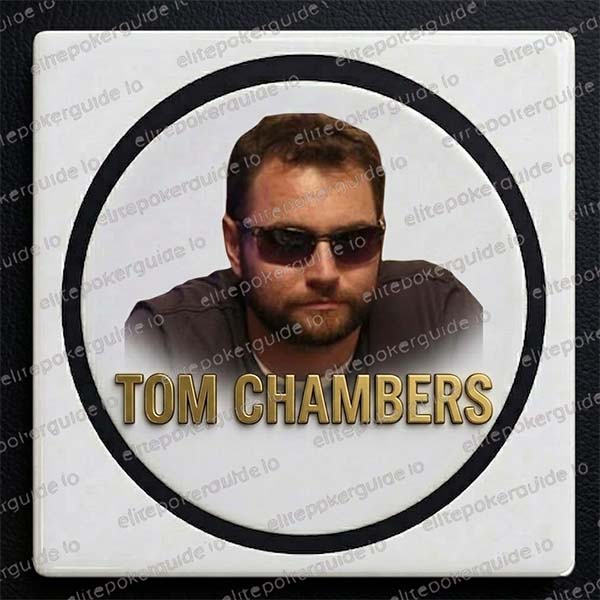
Tom Chambers — The Man Who Wrote the PLO Bible
Harvard graduate. Six years as a professional poker player. Four years as a Wall Street trader. Then back to poker — this time to write the most mathematically rigorous PLO curriculum ever committed to paper. Tom Chambers PLOTheory is not a course brand. It is the result of a decade of deep structural analysis of Pot Limit Omaha by someone who thinks at a fundamentally different level than most poker educators.
Tom Chambers — Full Biography
Tom Chambers was born in the Detroit suburbs in 1980. He graduated from Harvard University in 2002 with a degree in Intellectual History — a discipline that trains its practitioners to analyse how ideas evolve, interact, and replace each other over time. It is not an accident that the man who would later build the most structurally sophisticated PLO curriculum in existence studied the history of thought before he studied poker.
After Harvard, Chambers spent three years teaching and coaching basketball in St. Louis, followed by a year working as an actuary in Chicago — a career he walked away from to play poker professionally for the first time. Between 2006 and 2012, he built a formidable record as a professional player, specialising primarily in online 6-max PLO from 2008 onwards.
📅 Career Timeline
- 2002 — Graduated Harvard University, Intellectual History
- 2002–2005 — Teaching and basketball coaching, St. Louis
- 2005–2006 — Actuary, Chicago (resigned to play poker)
- 2006–2012 — Professional poker player (online 6-max PLO, mixed games, live tournaments)
- 2008 — Began deep mathematical research into PLO fundamentals; started student coaching program
- 2009–2011 — Wrote Advanced PLO Theory (850 pages, two volumes, $2,500)
- 2012 — Retired from full-time poker to work as a financial trader
- 2016 — Returned to poker: writing, coaching, videos, and long-term projects
- 2016–2018 — Produced 50+ theory and hand analysis videos for Run It Once
- 2016–present — Wrote Live Full Ring PLO and PLO MTTs; expanded PLOTheory curriculum
Playing Career & Academic Credentials
During his six years as a professional player, Chambers competed at the highest levels of both online and live poker. His primary online stakes were 1/2 to 5/10 PLO and 10/20 to 40/80 Mixed Games. Live, he played mid-to-high stakes tournaments on the WSOP circuit — over six consecutive WSOP series, he entered approximately 75 events and reached 5 final tables.
🏆 Notable WSOP Results
- 2008 — Final table, $2,500 Stud8/Omaha8 — Best finish: 2nd place
- 2008 — Final table, $1,500 PLO8
- 2012 — Final table, $3,000 PLO
- 2012 — Final table, $1,500 NLHE — Best cash result: 3rd place
- 2012 — Final table, $2,500 10-Game Mix
5 WSOP final tables across 75 events over 6 years. No bracelets — but the resume of someone who could compete at the game’s highest levels across multiple formats.
The mixed game background is significant. Unlike coaches who specialise narrowly in 4-card online cash games, Chambers built genuine expertise across O8, Stud8, Stud, Razz, 2-7 Triple Draw, and PLO variants (5-card, 6-card, PLO8, Big O). This breadth is reflected in the structural depth of his PLOTheory curriculum — his frameworks are built to generalise across formats, not patch-work exploits for a single game type.
His four years as a financial trader (2012–2016) are not a detour from his poker career — they are a formative part of it. Quantitative trading demands the same skills that define great PLO play: probabilistic thinking under uncertainty, multi-variable risk management, and the discipline to act on structural edge rather than intuition. When Chambers returned to poker in 2016, he brought a trader’s framework for thinking about EV and risk that permeates every PLOTheory volume.
The PLOTheory Philosophy: Theory First, Always
Tom Chambers makes a distinction that most poker coaches never articulate: the difference between the empirical approach (evaluating EV situation by situation, assigning ranges) and the theoretical approach (building structural game analysis upward from first principles). Most poker education is entirely empirical. PLOTheory is the opposite.
⚡ Chambers’ Core Principle: Replace “my opponent does X, I do Y” (exploitative reflex) with “Optimal play is X, my opponent does Y, therefore I exploit with Z” (theoretical grounding). The difference is not just philosophical — it is the difference between a player whose game is perpetually reactive and one whose game is structurally unbeatable.
The Five Tool Player framework — Mathematics, Psychology, Adaptability, Memory, and Logic — is Chambers’ model of complete PLO competence. Logic acts as the engine; the other four tools are the instruments it drives. This is not a metaphor. It is a working operational model for how to process information during a hand, and it maps directly onto how the PLOTheory curriculum is structured.
The curriculum produced by this philosophy is deliberately demanding. The flagship work — Advanced PLO Theory — runs to 850 pages across two volumes and carries a $2,500 retail price. It was never designed to be easy. It was designed to be correct. At ElitePokerGuide.io, every PLOTheory course is available with a FOREVER LICENSE at a fraction of that retail price — permanently owned, never expiring.
Complete PLOTheory Course Catalog — Available at ElitePokerGuide.io
All six PLOTheory courses are available at ElitePokerGuide.io with a FOREVER LICENSE — check the active coupons page for current discount pricing before you buy.
📘 Start the Climb — The Entry Point
The starting point for players new to the PLOTheory ecosystem. Start the Climb introduces Chambers’ foundational vocabulary and conceptual framework before the mathematical rigour of the main volumes — making the transition into serious PLO study achievable without prior theory training. If you are new to structured PLO study, this is where you begin.
📗 PLO Fundamentals — Core Concepts Before Theory
Bridges the gap between beginner PLO understanding and the full theoretical framework of the Advanced volumes. Chambers covers the core PLO concepts — power hands, the nuts, equity distributions, cumulative equity — at a level that prepares students for the combinatoric depth of Volumes 1 and 2. Essential for anyone who wants to extract maximum value from the flagship curriculum.
📙 Advanced PLO Theory Volume 1: Theory Foundations
The structural bedrock of all PLOTheory. Volume 1 establishes the empirical vs. theoretical study dichotomy, builds core PLO concepts from 52-card combinatorics upward, and introduces the equity distribution framework that underpins every strategic decision in the game. The most important factor of a starting hand — its equity distribution (smooth vs. polarised) — is established here with full mathematical rigour.
- Complete combinatorics from first principles — card removal, flop/hand interactions
- Cumulative equity: how minor redraws and blockers stack into profitable stack-off hands
- The empirical vs. theoretical framework dichotomy
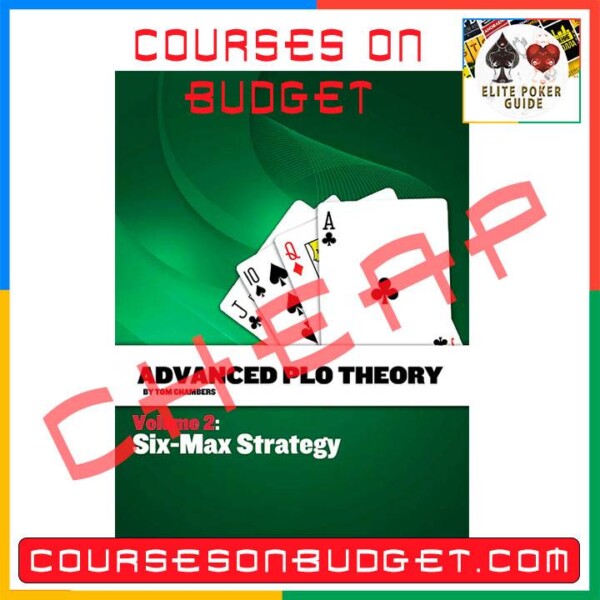
📕 Advanced PLO Theory Volume 2: Six-Max Strategy
Where the theory from Volume 1 becomes a precision weapon for 6-max cash games. Volume 2 introduces the Five Tool Player framework and deploys the full analytical arsenal against real post-flop situations. The two-axis board texture system (Wetness + Heaviness) and the starting hand character ratings (Polarity + Nuttiness) are signature contributions to PLO analysis that no other curriculum replicates.
- Five Tool Player: Mathematics, Psychology, Adaptability, Memory, Logic
- Board texture analysis: Wetness (drawiness) × Heaviness (range interaction)
- Starting hand Power Rating + Polarity + Nuttiness scoring system
- Horizontal and Vertical Partial Information frameworks
🎰 Live Full Ring PLO — The Definitive Live Game Course
The only course in the market that applies serious theoretical PLO analysis to the live full-ring environment. Live games are structurally different from online 6-max: varied blind structures, straddles, diverse stack sizes, and complex multi-way SPR distributions dominate the landscape. Chambers built an entire framework for this environment — including a live opponent archetype taxonomy that has no equivalent anywhere else in PLO education.
- Live Archetypes: Rigid TAG Grinder, Smart LAG, the BSD (table dominance motivation)
- Straddle dynamics and multi-way SPR distribution mapping
- Position selection: EP tight (10–12%), LP wider with positional leverage
- River Nuts Shifts: tracking which hand category holds the nuts as the board develops
🏅 PLO MTTs by Tom Chambers — Tournament Theory Module
Chambers’ structural framework applied to tournament dynamics. The ICM treatment here is mathematically grounded rather than heuristic — he quantifies precisely how tournament conditions increase the equity required to commit stacks, and how the optimal post-flop betting structure shifts under ICM pressure.
- Stack Strategy Spectrum: 150BB+ (full three-street value) → sub-20BB (flop commitment only)
- ICM distortions: large cbets restrict IP frequency and surrender realised equity
- Counter-intuitive chip leader dynamics: tighten when bad players donate to short stacks
- Bubble preservation vs. accumulation: the mathematical framework for each
PLOTheory Course Overview at a Glance
| Course | Level | Format | License |
|---|---|---|---|
| Start the Climb | Beginner | 4-Card PLO Intro | FOREVER |
| PLO Fundamentals | Beginner–Intermediate | 4-Card PLO Core | FOREVER |
| Advanced PLO Theory Vol. 1 | Advanced | Theory Foundations | FOREVER |
| Advanced PLO Theory Vol. 2 | Advanced | 6-Max Strategy | FOREVER |
| Live Full Ring PLO | Advanced | Live Cash Games | FOREVER |
| PLO MTTs | Advanced | Tournaments | FOREVER |
📚 Own the Entire PLOTheory Library. Permanently.
All 6 Tom Chambers courses available at ElitePokerGuide.io with a FOREVER LICENSE — a one-time price. No subscriptions. No expiry.
Paying retail price for these courses means overpaying by hundreds of dollars for identical content.
Who Should Study Tom Chambers?
✅ PLOTheory is for you if…
- You want to understand why optimal plays are correct, not just copy them
- You play or plan to play live full-ring PLO — no other curriculum addresses this format at this depth
- You use solvers (PioSolver, GTO Wizard) and want theory to contextualise what the solver is showing you
- You compete in PLO tournaments and want a rigorous ICM framework
- You are a serious student building a durable, long-term game
- You are transitioning from NLH to PLO and want to skip the trial-and-error phase entirely
⚡ Pair PLOTheory with…
- Cory Mikesell — Beating Fish in Omaha for exploitative online cash game tactics
- Cory Mikesell — Tournament PLO for PKO and satellite-specific strategy
- GTO Wizard PLO solver for spot-checking the theoretical lines Chambers builds
- The PLO Mastermind curriculum for additional 4-card and 5-card online depth
📐 Study Path Recommendation: Begin with Start the Climb → PLO Fundamentals → Volume 1 → Volume 2. Only then move to Live Full Ring or MTTs depending on your primary game format. The curriculum is deliberately sequential — each volume assumes the vocabulary and frameworks of the previous. Skipping steps is the most common and most costly mistake PLOTheory students make. See also our full Cory Mikesell vs PLOTheory comparison for a side-by-side breakdown of both schools.
FAQ: Tom Chambers & PLOTheory
Who is Tom Chambers in poker?
Tom Chambers is a Harvard-educated professional poker player, former financial trader, and the founder of PLOTheory.com. He played professional poker from 2006 to 2012, specialising in online 6-max PLO and mixed games, with 5 WSOP final tables. He is the author of Advanced PLO Theory (850 pages, two volumes), Live Full Ring PLO, and PLO MTTs — widely considered the most mathematically rigorous PLO curriculum available.
Is PLOTheory suitable for beginners?
Start the Climb and PLO Fundamentals are accessible entry points for players new to serious PLO study. The Advanced PLO Theory volumes (1 and 2) require a foundation in PLO concepts — attempting Volume 1 without the fundamentals courses will produce frustration rather than improvement. Follow the recommended study path above.
Where can I buy Tom Chambers PLOTheory courses at the best price?
All six PLOTheory courses are available at ElitePokerGuide.io with a FOREVER LICENSE — permanent ownership at a one-time price. Check the active coupons page for current discount codes. Unlike subscriptions on other platforms, a FOREVER LICENSE never expires.
Did Tom Chambers coach at Run It Once?
Yes. Between 2016 and 2018 Chambers produced over 50 videos for Run It Once, primarily theory content and deep-dive hand analysis. His RIO content covered PLO, mixed games (O8, Stud8, Stud, Razz, 2-7TD), and PLO variants (5-card, 6-card, PLO8). The PLOTheory curriculum is a substantially deeper and more structured version of the theoretical framework he introduced on that platform.
How does PLOTheory compare to Cory Mikesell’s courses?
PLOTheory wins on theoretical depth, combinatoric rigour, and live full-ring coverage. Cory Mikesell wins on format diversity (5-card, 6-card, HU, MTT), exploitative clarity, and beginner accessibility. Advanced PLO students benefit from both. See the complete breakdown in our Cory Mikesell vs PLOTheory head-to-head comparison.
Is the Advanced PLO Theory book available as a digital course?
Yes. The PLOTheory curriculum is available in module form — self-contained segments at individual price points — making it possible to study specific sections rather than purchasing the full 850-page work at once. All modules are available at ElitePokerGuide.io with FOREVER LICENSE pricing. The external reference resource is PLOTheory.com for Chambers’ official site and bio.
🏆 The Most Rigorous PLO Curriculum Ever Written — Now With a FOREVER LICENSE.
All 6 Tom Chambers PLOTheory courses at ElitePokerGuide.io. One-time price. Permanently yours.
No subscriptions. No expiry. Build the theoretical foundation that your opponents never will.
 PLOTheory Advanced PLO Theory Volume 2
 PLOTheory Advanced PLO Theory Volume 1
 PLOTheory Live Full Ring PLO by Tom Chambers
 PLOTheory PLO MTTs by Tom Chambers